Switch to mobile version

humanity

Post image for The Purpose of Life, Revealed

Last week I ran into a few online discussions about those big, big questions that often come up in late-night conversations: Why are we here? What is our purpose?

Strictly speaking, as members of the human species we do have a purpose. But we didn’t choose it, and it might not be us who stands to benefit from it. In fact, you might find our purpose quite upsetting. Maybe you don’t want to know. If you want to take the proverbial “Red Pill”, read on. While it might be alarming at first, it is also very enlightening, and could change forever how you view yourself and what you want to do with your life.

Today’s post is a particularly long one, but it does contain the meaning of life, so it may be worth your while.

To understand it we have to start with a quick biology lesson.

Everything you do, you do for you

It really seems like no matter what we do, we are always serving ourselves in some way. Every action you take is to fulfill some desire that you have, whether that desire is to eat a chocolate cake, run away from a bee, or to help your nephew with his homework. You do it because it promises to deliver something you want.

Even charity and philanthropy always seem to have some identifiable benefit to the giver: recognition, tax rebates, or even just a good feeling inside. There are always incentives for our behavior, and so it seems that we cannot escape self-interest.

That’s okay though. Self-interest doesn’t need to take the form of blatant selfishness, as we tend to call it — taking something for yourself at the expense of somebody else. But sometimes it does, in the form of theft, greed, or physical domination.

Most of us have learned that we can usually serve ourselves better by complying with society’s values than we could by violating them. Approaching life by stealing everything you need would almost certainly lead to a less desirable situation for you than working for and buying everything you need. Read More
riot cops

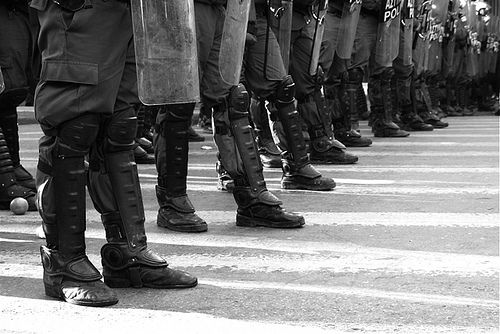
There is a quote, much celebrated by activists, cynics, and political science students the world over, that I think could use a second look:

“It is no measure of good health to be well-adjusted to a profoundly sick society.” ~Jiddu Krishnamurti

I like Krishnamurti, and I think he’s being misunderstood here, but I’ll get to that. Taken at face value, I disagree.

Activists, particularly those who nurture a general dislike for humankind at large, prize this snarky quote because it seems to validate the notion that only others need to change.

If our society is profoundly sick and we should refuse to adapt to it, then what is it that we’re supposed to adapt to? Or perhaps the sneaky insinuation is that some of us are already perfect, and no adjustments are necessary. Indeed, the implication of activism seems to be that it is others who need to correct their course — CEOs of petroleum companies, mindless consumers, fans of Glenn Beck, people who talk during movies or don’t use their turn signals — they are society’s sickness, and if they can be made to shape up, we’ll finally be sitting pretty.

Society does have its problems: crime, poverty, war, pollution, overpopulation and political corruption. It’s no utopia, clearly, but what is the best way to approach these problems?

Misanthropes and other “the-world-has-gone-to-shit” types would have you believe the solution is to identify the groups and individuals responsible for the “sickness” of society, and find a way to disempower them, expose them, or destroy them. With some grassroots support and some elbow grease they can get some new policies in place, install a new breed of political leaders, and usher into fashion a more progressive philosophy about how to govern, do business, and treat your fellow man… and in the mean time, sourly refuse to adapt to the human world as it is now, because that would only encourage the evil corporations and lying politicians who make it so troublesome.

But that won’t work. The “sickness” is not that some nasty people have come into power, but that human beings across the board are still working primarily from their stone-age instincts. The detractors of The Establishment are just as consumed by their own needs for personal power, righteousness, security and social dominance as the people they so proudly hate.

We are so newly removed from our original stomping ground that we are almost completely inexperienced with running civilizations smoothly. We’re much more efficiently wired to orchestrate a successful mammoth hunt than govern a nation intelligently. Civilization is barely out of the package. Read More

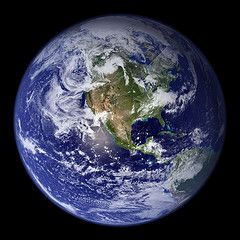
earth

This week celebrated physicist Stephen Hawking suggested that alien life almost certainly exists, and humans should do everything we can to avoid contact with it.

He reasons that contact with aliens would probably be fatal to us, likening it to the European conquest of the New World:

“If aliens ever visit us, I think the outcome would be much as when Christopher Columbus first landed in America, which didn’t turn out very well for the Native Americans. […] We only have to look at ourselves to see how intelligent life might develop into something we wouldn’t want to meet.”

Ouch. I’m not sure why I was so surprised to hear this point of view from Dr. Hawking.

I suppose, in the absence of any actual information about alien species, my entire concept of them is built from movies and TV shows. In those shows, aliens tend to do one of two things: extend a gesture of cosmic friendship and love, or violently abduct/dissect/probe us and vaporize our cities. I always thought the movies that portrayed aliens as senseless killers (Independence Day comes to mind) were not as “realistic” as ones in which the aliens strike some sort of rapport with us humble homo sapiens (think Close Encounters of the Third Kind.)

One ridiculous feature of movie aliens is that they almost always look something like us — bipeds with eyes, nose (or at least nostrils) and mouth. Sometimes they add some slime or mucous to make them a bit more foreign. These depictions are dazzlingly unimaginitive — it’s really incredible how we can’t seem to let go of the idea that sentient aliens would just be “men from outer space.” Truth is stranger than fiction, and since we have no real knowledge of extra-terrestrial life, we have no starting point for imagining them, other than ourselves.

But that’s movies, and I guess I never really thought one of the world’s top scientific minds would conclude that aliens would indeed try to kill us if they had the chance.

It made me think: is that what humans would do with aliens if we found them? Sure, we’ve destroyed all sorts of terrestrial species (usually without trying) and sure, we destroy our own kind on a regular basis, but I think humanity at large would regard an alien encounter as an opportunity to connect, rather than conquer.

No, I don’t think we’d be as cold-blooded with our galactic neighbors as Hawking believes they would be with us. For all the nasty things humans can do, there is an earnest quality in us that respects life and wants to see it do its thing. We are fascinated to witness rare earth animals in their natural habitats, and I think we’d be more likely to value and study alien life than to barbecue it. Read More

sponge

There is a pile of filthy pots and pans in the corner of the kitchen, and it’s tearing us apart.

For six weeks I have been living in a hostel in Te Puke, New Zealand, the kiwifruit capital of the world. Te Puke is not a tourist attraction, so travelers generally only come here to spend a month or two working in the orchards, then they hit the road again. This means there is very little accommodation in town, because it is difficult to make a hostel pay for itself with virtually no tourism.

I am staying in a bunkhouse at the edge of town, with about 30 other long-term guests. Because the turnover is low for a hostel, friendships have time to form and there is a warm social vibe among the guests. But a tense relationship exists between us and the owners, and it has something to do with cookware. Read More

nietzsche

If there’s one thing Friedrich Nietzsche did well, it’s obliterate feel-good beliefs people have about themselves. He has been criticized for being a misanthrope, a subvert, a cynic and a pessimist, but I think these assessments are off the mark. I believe he only wanted human beings to be more honest with themselves.

He did have a remarkable gift for aphorism — he once declared, “It is my ambition to say in ten sentences what others say in a whole book.” A hundred years after his death, Nietzsche retains his disturbing talent for turning a person’s worldview upside-down with one jarring remark.

Even today his words remain controversial. They hit nerves. Most of his views are completely at odds with the status quo.

Here are 40 unsympathetic statements from the man himself. Many you’ll agree with. Others you will resist, but these are the ones to pay the most attention to — your beliefs are being challenged. It’s either an opportunity to grow, or to insist that you already know better. If any of them hit a nerve in you, ask yourself why.

***

1. People who have given us their complete confidence believe that they have a right to ours. The inference is false, a gift confers no rights.

2. He that humbleth himself wishes to be exalted.

3. The surest way to corrupt a youth is to instruct him to hold in higher esteem those who think alike than those who think differently.

4. There are no facts, only interpretations. Read More

fern

New Zealand is a black sheep among nations. Having spent the last 60 million years isolated from the rest of the continents — longer than any other major land mass — life has had a long time to do its own thing here. The vast majority of native trees and animals are found nowhere else. They’ve all learned their own tricks for contending with their unique surroundings. In particular, many birds, including the iconic Kiwi, found no reason to bother flying because there was nothing on the ground that would eat them.

An important lesson from a clever plant

One of the more unusual New Zealand plants is the Lancewood. Most of the specimens you’ll encounter look something like a tall broomstick decorated with menacing, saw-like leaves. They are rigid and serrated, and angled downwards towards you or any other potential assailant.

A young Lancewood

The Lancewood has a very bizarre feature: It completely transforms itself after reaching a certain level of maturity. Its long, toothed leaves give way to more lush, more conventional broad leaves. It actually begins to look like other trees. The plant’s two forms are so unlike each other biologists once thought they were two totally different trees.

A mature Lancewood

Biologists couldn’t understand why a plant would evolve to do that. When an organism develops a distinct quirk like that, there tends to be an evolutionary reason for it. In other words, it must help the life form out somehow.

Some scientists guessed that the serrated, downward-pointing leaves served as a defence against large, ground-dwelling plant-eaters while it was still small enough to be vulnerable. But there was a problem with this theory: New Zealand doesn’t have any large, ground-dwelling plant-eaters. The island nation doesn’t have any native land mammals at all, only chicken-sized flightless birds that couldn’t pose a threat to a plant that size.

The Lancewood’s odd behavior remained a mystery for some time. Read More

world peace

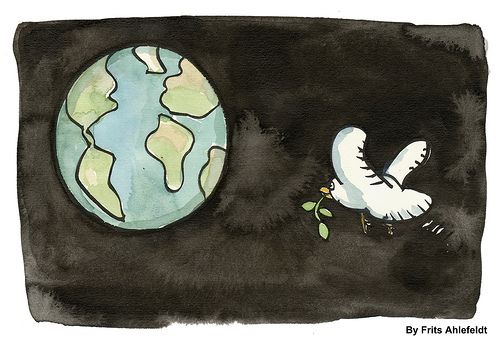
Despite the earnest efforts of sixty years of Miss USA contestants, world peace has not arrived on our doorstep. The UN has not managed it, nor did John Lennon or Oprah or The Secret. Religion sure made a mess of the effort altogether, and I don’t hold high hopes for China to pull it off, despite their latest efforts.

Something tells me it’s not coming at all.

If that’s true, could we live with that?

I say let’s forget the idea of world peace. Let’s admit it will never happen and get on with our lives the best we can. It is naive to think that progressive government policy, awareness campaigns, and heartfelt pleading will bring about this holy grail of achievements, and that is because human beings are not capable of world peace. There, I said it.

Let’s get real here. Humanity will never co-operate. It’s far too big and varied for that; there is no way to even communicate amongst the whole populace, let alone get everyone on the same page at the same time. Just trying to get eight people on the same page to organize a camping trip is trouble enough for most.

The vast majority of us really have to work at keeping ourselves in a stable, pleasant mood, so why do we concern ourselves with a task that is so utterly beyond us? If we think we can engineer a change in the philosophy of billions of people we’ve never met, yet most of us cannot even manage to fulfill our New Year’s resolutions, we’re kidding ourselves big time. Read More

I forged my own blade yesterday, from an unassuming piece of plain steel. With some expert instruction, I pounded it on an anvil, ground the blade down, fitted it with a brass hilt, polished and sharpened it. The handle is made out of native timber that was salvaged from a dismantled insane asylum. Read More

A cross to bear

Though the hysteria surrounding the H1N1 flu has left the entirety of the news-watching world with the encouraging habit of frequent handwashing, it is hard to call it anything but an overreaction.

Not to dismiss the crushing impact of even one person’s death to their loved ones, but when we venture into the realm of cold numbers, H1N1 just doesn’t warrant this level of acute, global paranoia. Thus far, the worldwide toll is just short of eleven thousand. That’s equivalent to about a summer’s worth of highway deaths in the US alone, or about 18 hours’ worth of tobacco-related deaths. But that’s not news.

I won’t delve into the media’s reprehensible M.O. of manufacturing widespread panic in this article, though. The point I want to make has more to do with our place in the world. From our presumed throne at the top of the food chain, we often take it somewhat for granted that we’re a more advanced creature than any other, certainly better than anything with no brain and no face. Read More

blame

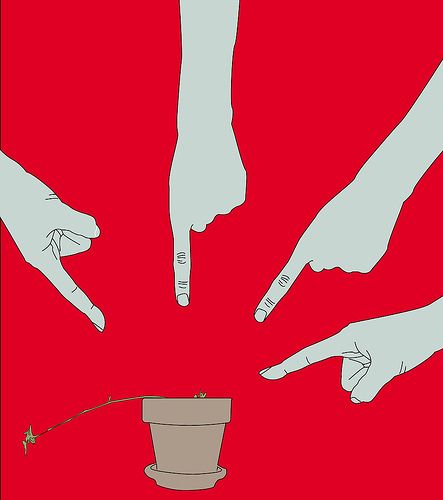
“I hate the person who invented Mondays.”

I saw that phrase on someone’s Facebook status a week or two ago, and it made me smile. It’s definitely an understandable sentiment. I remember miserable grade-school mornings, being dragged out of bed by my mom. All I could do was grumble bitterly, “I hate the person who invented school!”

And I really did. I could almost picture this person: a crusty, stern Englishman with thick glasses and a white mustache, rapping a stick on the chalkboard. What a nasty thing to do to me, to invent school. I hated him.

At least, I hated him during those moments when I was being dragged out of bed and shuffled off to school. In fact, I’m sure there were times when I realized that there probably wasn’t one person out there in history who was solely responsible for inventing school and spoiling my mornings. But at that moment at 7:30am when I was yanked out of my pleasant dreams, he was ruining my life. Read More

Desktop version

Raptitude is an independent blog by . Some links on this page may be affiliate links, which means I might earn a commission if you buy certain things I link to. In such cases the cost to the visitor remains the same.