Switch to mobile version

individuality

Post image for The Thing That Makes This All Happen

How many times in my life have I stood with four or five strangers at a street corner, waiting for the pedestrian light to change? 2000? 5000? Who knows. But I do know that in almost none of them do any of us want to be precisely there.

It’s the sort of moment that has a distinctly “in-between” character to it. It feels like a necessary but boring preamble to a more ideal moment which seems to be waiting for you somewhere across the street, but is really only in the mind.

Most moments are like this. Which means, of course, that most of human life is like this: not where we want to be. It’s mostly in-between.

If you could divide a human life up into two parts: the time spent feeling a sense of in-between, and the time spent feeling a sense of “arrival” I’d bet the proportions would be staggering — certainly 90-something percent “in-between”, probably closer to 100 than 90.

We share a lot of those kinds of moments with other people, even though the experience usually feels like a rather individual one, and we’re unlikely to think much about the others in it. Waiting in elevators. Going through the motions at work at 2:27 on an idle Tuesday. Riding the bus, again.

The “in-between” character present in the vast majority of our moments is created not by the moment’s actual details but by the persistent state of preoccupation of the person experiencing it. Preoccupation is the typical human experience, and it’s nothing other than the experience of an abstract past, future, or hypothetical moment in the mind stealing your attention from the one that’s really happening.

I’ve long believed that tedium is only a pattern of thought, not circumstance.  Boredom is never a situational reality, only a self-defeating way of relating to the moment at hand, which always contains more detail and possibility than you could ever explore.

Again, this is normal. So my state of mind — I can’t speak for you — isn’t always receptive to the freshness and magnificence of “mundane” moments, even though I am now convinced that those qualities are always there behind my preoccupations.

But depending on the intensity of the preoccupying thoughts, I’ve found there are some pretty reliable ways of tapping into those qualities, even when the present moment is of that archetypal, in-between type you find in parking lots and waiting rooms.

An example from work: I often find myself at site meetings, which typically take place in a boxcar-sized field office, around a collapsible table with plastic folding chairs, populated by a handful of contractors, engineers, surveyors and developers. These meetings have a very predictable dynamic, with everyone waiting for a chance to bring up their biggest concern, nodding impatiently while others bring up theirs. They have a predictable, tired vocabulary (working days, “mobilizing”, change orders, tie-ins, inverts, grades, quantities) that seems to blur countless past and present and future moments together as if they are one indistinguishable, perpetual scene with no real unique characteristics and certainly nothing to feel and wonder or excitement about.

These patterns, if you experience them every day (and your workplace certainly has its own) can become almost unbearably ordinary. If you can somewhat imagine what a tax accountant feels like this time of year when they look at yet another T4 or a W2, or what a McDonald’s employee feels like when they come back to the same fries smell after two weeks off, then you know the stifling feeling of over-familiarity I’m talking about.

At this recent meeting, perhaps the tedium hit a breaking point in me and I slipped into a genuine recognition that behind those boring patterns, right in the room with me, was a damn miracle.

Eight beating hearts.

All the over-familiar talk in that room, all the annoying jargon, the impatience, the endless dialogue about construction schedules and the state of the industry, was the product of something truly astounding and humbling. Every instance in that scene of someone getting quietly worked up, getting self-righteous, getting talked over — or getting bored — was driven ultimately by one of eight beating hearts. And each was driving its owner to something. Some action, some attitude, some thought. Only because that’s what it does.

Why did the chicken cross the road? A beating heart, no other reason. Read More
Post image for The World is Quietly Asking You to Get Your Shit Together

The police officer sat in his ghost car for a few moments before getting out, letting me wonder why he stopped me. I knew I wasn’t speeding, and that made me worried.

This was yesterday.

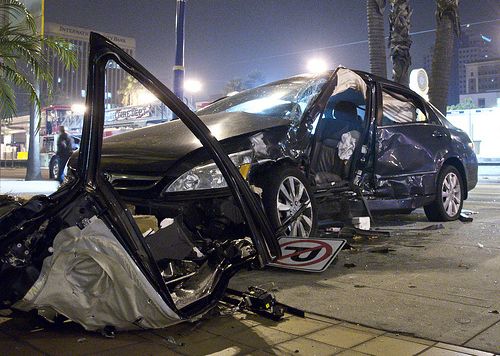
Over the last 48 hours I’ve been pummeled with what I can only take to be clear messages to get my shit together in certain areas of my life. I’m not sure I’m a believer that these kinds of jarring events are signs from above, but maybe it doesn’t matter — it makes sense to treat them like they are.

Turns out my license and auto insurance expired three weeks ago. A cop in an unmarked car spotted my outdated tag and pulled me over. He gave me two pink forms entitled “You have been charged with an offense”, saying that I have to appear before a magistrate in a few months to receive my fines.

As I was staring at the forms, sighing over however many hundreds of dollars they will ultimately cost me, he said, “Always better to find out this way.”

I’ve never let my insurance lapse before, though I have come close. I always get a reminder in the mail at the end of the year from Public Insurance, and I guess I had come to count on that letter to make sure I remembered to fulfill this extremely important responsibility. Of mine.

When I checked my “Automobile” file at home, it turns out I had received it in December, but I mistook it for an informational letter about minor changes to the insurance price structure, even though it clearly said “RENEWAL NOTICE” at the top, and IT’S TIME TO VISIT YOUR INSURANCE AGENT somewhere in the middle. So I never acted on it, just filed it for reference.

I only got pulled over because I was in the middle of trying to make up for another stupid oversight on my part. I was hurrying home at lunch to try to track down my landlady, because it happened to be the last possible day to renew my lease. If I didn’t have my form filled out and handed in by today, I could lose my apartment. They gave me the form in mid-December. Interestingly it was dated the same day as the insurance renewal notice. Read More

Post image for Deal With it, Princess

Here’s a short fable that might be about you. Or someone you know.

Once upon a time long ago, after the invention of clothes but before the invention of shoes, there was a fabulous princess.

Born into wealth, she spent her days not working but rather wandering about her father’s vast kingdom, skipping down the pathways, stopping now and then to bask idly in her good fortune, or sometimes to frolic.

One day she was skipping along, and she stubbed her bare toe on a rock sticking out of the pathway.

She was quite upset, and became horrified at the thought of all the other aggressive and dangerous rocks that might be out there. So she pranced, at a cautious half-speed, back to the palace where she stormed into to the office of King’s closest advisor. She demanded that he have the entire kingdom sealed in leather, so that she never would have to suffer the pain and humiliation of stubbing a toe again.

After a moment, the advisor realized she was quite serious, and he began to to sweat a little. Her request, even if it could actually be carried out, would be hideously expensive even for such a fantastically wealthy kingdom. But the princess had her father wrapped around her finger and was unaccustomed to not getting what she wanted. Denying her wish would upset the king greatly, perhaps costing the advisor his head.

So he proposed a pragmatic solution. “Your highness, what if instead of paving the entire kingdom in leather, we create leather garments that we can slip onto your feet, so that you will be protected wherever you go, in our kingdom and even beyond?”

Being a fabulous, materialistic princess, she loved the idea and shoes were invented that day. By the time she died she had two thousand pairs.

(Traditional fable, hat tip to Jon Kabat-Zinn)
***

Such a wealthy and demanding princess might actually have had the worldly power to pull off her original solution, or at least most of it. Money and influence, external power in its two classic forms, were not normally limited for her. So if she could have the whole kingdom rendered harmless by gilding it in leather — or even pleather if the overlay had to be so large it drove cows to extinction — it would be incredibly costly and cause all sorts of unforeseen practical issues, but her problem could indeed be solved.

A person without vast reserves of wealth and power, such as one of her subjects in the village, wouldn’t have this option and would have no choice but to suffer a lifetime of scraped heels and disjointed toes. After all, if you have unlimited control over circumstances, then you have no problems.

But nobody has unlimited power over the world around them. So a wiser person brought to the princess’s attention, in a very diplomatic manner, that the problem she perceived as being everywhere only ever existed at the point of contact between her and the world around her.

Her extensive resources were usually enough to obliterate anything she perceived as a problem. She had always needed money and influence to solve her problems, because she had always been in the habit of defining a problem as the thing that vexed her, rather than what it really was: the friction between herself and that thing. Read More

Post image for How to Make Trillions of Dollars

Before I get into it, I must say that I don’t recommend that you do this. I’m sharing this strategy for information purposes only, so that you can understand the playing field you’re working with, and can make better personal choices for how you make and manage your money.

I do encourage you to become a millionaire, if that’s something that interests you. If it’s billions you’re after, I’m a bit suspicious but I’ll give you the benefit of the doubt. Aspiring to trillions, though, is the domain of the wicked alone and we won’t be able to be friends any more.

The big money isn’t in creating products, it’s in creating customers. A single, lifelong customer who lives his life spending the way you want him to is worth six or seven figures. A single one. Creating millions of these is the only way to make trillions.

You can make millions by selling a great product to people who need it, but you make billions and trillions by conditioning an entire nation of people to react to every inconvenience, every whim, and every passing desire or fear by buying something. Read More

Post image for If The World Was Populated by Six Billion of Me, I’d Totally Be Gay

Even now, I do it. After ten-plus years of struggling to be less stupid with my thought processes, when someone else’s bad behavior gets to me, I still catch myself thinking “Now, if everyone thought like me, the world would be a much better place.”

People wouldn’t stop and chat in doorways. Nobody would enter a quiet room loudly. Nobody would drive 49 in a 60, or 79 in a 60. There would be no littering, and definitely no chewing with your mouth open.

I do remember coming to that exact conclusion one day: that everyone should be like me, and then the world’s problems would be solved. I was maybe eleven.

I don’t remember what triggered it exactly but I had certainly just been wronged somehow, maybe by some kid who had chained his bike across the whole bike rack, leaving me no choice but to lock mine to a stop sign (which everyone knows you can just lift out of the ground).

Why didn’t he think about all the other kids with bikes when he did that? I knew I would have recognized the critical importance of leaving as much space for others as possible. It should have been the first thing on his mind, no matter who he was.

Whatever the offending act was, at that moment in my life I was fervently convinced that my thinking and behavior was damn near perfect, and that the world was imperfect exactly insofar as other people were unlike me. It seemed so obvious.

Seeing as how at the time I had about as much insight into my behavior as, say, George Costanza — who, in a short-sighted moment of his own, almost certainly would have elected to have the world populated with six billion of himself — in my fit of righteous indignation I was unable to see that a world populated with six billion of me would be a freakish and frightening place. Read More

Post image for So This is Christmas… and How Are You?

It’s Christmas time, and even though the holiday season is lauded as a time of giving and thinking about others, it’s also a time when people end up thinking about the state of their own lives.

For a number of overlapping reasons, this time of year often triggers some pretty heavy self-reflection, whether or not we want to call it that. In households around the world, some common scenarios are poised to unfold as the holiday season rolls in:

As the average person’s spending hits a peak, this time of year we often think about our finances, and how they got to be that way. Is this the one month when your Visa card will carry over a balance? Or is that every month? Many people perennially find themselves sitting across the dinner table from someone with whom there’s a history that might be… touchy at best. Old wounds can surface, as well as the reasons behind them, especially with a bit of wine. With the seasonal proliferation of Salvation Army Santas and World Vision commercials, we sometimes find ourselves in an uncomfortable reflection about what we actually contribute to society and the people in our community. Do you change the channel when “So This is Christmas” comes on, over images of starving children? How do you feel about that? By the same token, we often can’t help but reflect on what kind of family member we’ve been, this year and in years past. Any lingering disappointment with regard to the fulfillment of familial roles — in ourselves about others, in others about ourselves, and in ourselves about ourselves — tends to reach a head in December, for some reason. Read More
Post image for What to Do About the World’s Suffering

In all the emails I receive from readers, perhaps the most common theme is a question in this vein: how can a person be at peace with the world when there is so much suffering going on?

I don’t think I need to start rattling off specifics here — virtually every story in every newspaper is a tiny, nominal record of horrendous suffering for someone somewhere. Crimes. Deaths. Famines. Wars. Fires. Floods.

How do we live with so much suffering going on? How can I do so much as enjoy a bagel with a clear conscience while so many people are enduring unspeakable suffering?

I never really had a satisfying answer for that question most of my life, and so my only strategy was distraction. Get into something more immediate, more consuming, and those thoughts go away.

But it never really sat right with me until I began to question the usefulness of those thoughts. I think the key lies in understanding the difference between two oft-misunderstood responses to suffering.

Sympathy and empathy are often used interchangeably, and though they are definitely not the same thing, I can’t really say my definitions are the right ones. But I think if you read on, you’ll understand why it’s so important to make a distinction.

Both are related to feeling the suffering of others. The more common reaction is sympathy, which is essentially feeling bad because someone else feels bad. It doesn’t require an understanding of the nature of the other person’s suffering, only a mental acknowledgment that they are suffering. When you react to the suffering of another with sympathy, it means you are suffering over their suffering. However, as we suffer we become less conscious. In a state of suffering, wisdom disappears, reactivity takes over, and you begin to feel helpless.

Empathy is more subtle. It is not a reaction, but rather a capacity to be aware of the suffering of another. In sympathy we can be aware that another person is suffering, though we remain preoccupied with emotions and thoughts about the suffering, making it impossible to stay keenly aware of it.

To cultivate empathy requires that you remain receptive and stable — able to listen without judgment, to stay aware without getting indignant. Above all, it requires that you do not make their suffering yours. Read More

Post image for You Must Go Do the Next Thing

I had the privilege of being present at my father’s death. It was not like I expected.

With illness you see the person — the personality — fade over time, and you come to expect that death will simply be what you call it when there’s nothing left. In light of this it’s easy to imagine that a life can taper down to nothing without any hard edges. But death itself does come down to a single moment. He was breathing, and a moment later he was not.

Having been aware of his prognosis for five years or so, I had already envisioned the moment many times, but I had it all wrong. I expected it to trigger intense grief, hysterics.

Instead, I found I felt intensely happy for him. He had arrived the finish line, and I was there to witness it. It struck me, with all the suddenness of a lightning flash, that he was the only one in the room with no problems at all. Not a trace. All his uncertainties, needs and worries evaporated, while ours still filled the room. I watched intently as he was freed from the enormous weight of simply being alive, an unbelievably heavy thing which I’d somehow lost track of until that moment.

That heaviness is something I had never fully appreciated until I saw somebody being liberated from it. The four of us at his bedside very clearly still carried it. It hung in the room like wet laundry. It was in the hallway too — in the nurse’s faces, in the other patients, in their weary families. And we were grieving for… who? The man with no more troubles.

I do forget it sometimes — that life is a constant, forceful mixture of push and pull, a ceaseless assault of needs and hopes. As pervasive as it is, we appreciate the weight of this tumult about as often as a goldfish thinks about water. Life’s current is heavy and unpredictable and bigger than us, and as long as we’re alive we are at its mercy.

Altogether I do think it’s worthwhile to be in it, for most of us, most of the time. Not that we asked for it, but our fate is to dance with this immense force until it lets us go. So we better learn to dance.  Read More

Post image for If the election really mattered to you, you’d do more than just vote

Being Canadian, I’m not able to vote in the US Midterm Elections tomorrow. I don’t think I would though.

I’ve always been a faithful voter, but last week my city voted for mayor, and I didn’t go. I think I may be done with voting forever.

It wasn’t to make a stand. It wasn’t to pronounce my disgust with the candidates. I didn’t tell anybody who didn’t ask.

Last May in Australia I found myself in an argument with a clean cut, politically-conscious English traveler about the usefulness of voting. With simple logic and simple math, he shot down every pro-voting argument I made. I didn’t like it one bit, and never admitted defeat, but I had no leg to stand on. Before we parted, he pointed me to an article (written by beloved economist Steven Levitt) that made me finally let go of my stubborn belief that my habit of voting is a useful one.

I grew up in a family where it was a forgone conclusion that good people voted, lazy and cynical people didn’t, and that’s all there was to it. Including municipal, provincial and federal elections, I think I’ve only missed one since I turned 18. I’ve been a committed voter for years and not one of my votes ever made any difference.

You see, I have never voted in an election that was decided by one vote. So looking at it rationally, in every single one of the elections I’ve voted in, the result would have been the same whether I voted or not.

Elections that are truly close are exceedingly rare. Around the world, there are about a half-dozen public elections on record that were decided by one vote, but these were all tiny elections: 3 or 4 thousand total votes. Even on that scale, the vast majority of elections are decided by a margin that dwarfs the entirety of any individual’s voting power.

For your vote to have made any difference to the outcome, the election must have been decided by your single vote. Knowing the odds of influencing an election, it makes no rational sense to vote. I’m not the first person to point this out.

Okay. Fair enough. Your vote never affected the outcome. Most of us can accept that. But that doesn’t mean there’s no reason to vote, does it?

I have not found a convincing reason. But here are the typical arguments: Read More

Post image for A Shocking Revelation About Human Nature

The results were horrifying. Nobody suspected it could be that bad, not even close.

In 1961 a controversial experiment was carried out that made some chilling discoveries about human nature. Psychologist Stanley Milgram wanted to know how it was possible that so many people co-operated to commit the atrocities of the Second World War. They couldn’t all have been sociopaths, yet thousands and thousands of people did unspeakable things to innocent people, and millions more looked the other way.

Is it really that hard to stand up to authority?

Milgram devised an experiment that went like this:

Forty subjects were recruited to participate in an experiment “on learning and memory”, having answered a newspaper ad offering a modest payment for an hour of their time. Each of the subjects were informed that they would be compensated fully as long as they showed up, regardless of their performance in the experiment.

Upon arrival, each subject met with two people. The first was a man in a white labcoat purported to be the scientist conducting the experiment. The second was another person who was supposed to be a fellow subject, but whom was actually an actor. The two subjects drew slips of paper to see who would be the “teacher” and who would be the “learner” in the experiment.

It was rigged: both slips said “teacher,” so the real subject was always given the role of teacher, though he was under the impression that he’d had an equal chance of being the learner. The actor always played the learner.

The experimenter then announced that the learning was to be reinforced by electric shocks, which would be administered by the teacher on the learner whenever the learner gave an incorrect response to a simple memory test. Each teacher was given a 45-volt sample shock to get an idea of the shocks they would be giving.

The teacher was intentionally allowed to witness the learner being strapped to a chair, with electrodes fixed to him, before being ushered into the adjacent room, where he would be stationed in front of an electric shock generator. The experimenter sat behind the teacher, holding a clipboard. Read More

Desktop version

Raptitude is an independent blog by . Some links on this page may be affiliate links, which means I might earn a commission if you buy certain things I link to. In such cases the cost to the visitor remains the same.