Switch to mobile version

individuality

Post image for 9 Mind-Bending Epiphanies That Turned My World Upside-Down

Over the years I’ve learned dozens of little tricks and insights for making life more fulfilling. They’ve added up to a significant improvement in the ease and quality of my day-to-day life. But the major breakthroughs have come from a handful of insights that completely rocked my world and redefined reality forever.

The world now seems to be a completely different one than the one I lived in about ten years ago, when I started looking into the mechanics of quality of life. It wasn’t the world (and its people) that changed really, it was how I thought of it.

Maybe you’ve had some of  the same insights. Or maybe you’re about to.

1. You are not your mind.

The first time I heard somebody say that — in the opening chapter of The Power of Now —  I didn’t like the sound of it one bit. What else could I be? I had taken for granted that the mental chatter in my head was the central “me” that all the experiences in my life were happening to.

I see quite clearly now that life is nothing but passing experiences, and my thoughts are just one more category of things I experience. Thoughts are no more fundamental than smells, sights and sounds. Like any experience, they arise in my awareness, they have a certain texture, and then they give way to something else.

If you can observe your thoughts just like you can observe other objects, who’s doing the observing? Don’t answer too quickly. This question, and its unspeakable answer, are at the center of all the great religions and spiritual traditions.

2. Life unfolds only in moments.

Of course! I once called this the most important thing I ever learned. Nobody has ever experienced anything that wasn’t part of a single moment unfolding. That means life’s only challenge is dealing with the single moment you are having right now. Before I recognized this, I was constantly trying to solve my entire life — battling problems that weren’t actually happening. Anyone can summon the resolve to deal with a single, present moment, as long as they are truly aware that it’s their only point of contact with life, and therefore there is nothing else one can do that can possibly be useful. Nobody can deal with the past or future, because, both only exist as thoughts, in the present. But we can kill ourselves trying. Read More

Post image for Being Healthy is Not Normal

The figure is inching upwards. 70 per cent of Americans are overweight or obese.

That’s seven out of ten people walking down the street, not excluding you. It will be three out of four in a decade.

Luckily for my health, I’m not quite American, I’m only Canadian. Canada, the land of fresh air and slightly smaller fountain drink sizes, is marginally better healthwise. Only six out of ten of us are above a healthy weight.

This means, statistically speaking, that in either country it is normal to be fat. I’m honestly not quite sure if I’m part of the four or the six. Either way, as I age, I’m edging toward the fat end.

I always thought I was one of the healthy ones, but just recently it’s dawned on me that I’m not, no matter which side of that 60/40 split I land on. I think most of us who consider ourselves to be of average health are much further from good health than we think.

Why is health the number one concern for so few of us? Why is it normal for everything else to be more important? Good health improves the quality of everything else: your working life, your outlook, your self-esteem, your energy levels, your confidence, and your ability to do just about everything.

I know some people are probably thinking, “Speak for yourself!” You run ten miles a day, eat a strict paleo-diet, do yoga on the beach at 5am and you never take elevators.

I admire you, but you are in a rather slim minority, and you can stop reading now if you like. This post is for everyone else — those of us who do buy vegetables but also have the not-quite-infrequent binge on wings or ice cream. Those of us who have to tell our host to take the bowl of cashews away. Those of us who detect in ourselves a secret joy when we realize we’ve forgotten to bring a lunch to work, and have “no choice” but to get drive-thru. Those of us who are steadily fulfilling the average adult’s fate of gaining one pound a year (maybe two) until we die.

For many of us, getting into good shape is a nagging “should” in our lives that we never really tackle. Life gets in the way. After all, you’re still in okay shape, aren’t you? Read More

Post image for 28 More-Than-Just-Clever Remarks From One of History’s Great Smartasses

No one could turn a phrase like Oscar Wilde, but I think the truth in Wilde’s remarks is often overlooked because of how witty he made them.

Though he was known primarily for his wit, Wilde had a dramatic and difficult life, perpetually running afoul of society’s values, giving him some poignant things to say about humankind. It’s easy to have a quick laugh at an Oscar Wilde quip without recognizing the profound statement he is really making about human beings and their values.

The following are more than just snarky comments. Laugh, but don’t forget to think too.

***

1. Fashion is a form of ugliness so intolerable that we have to alter it every six months.

2. All women become like their mothers. That is their tragedy. No man does. That’s his.

3. What is a cynic? A man who knows the price of everything but the value of nothing.

4. A true friend stabs you in the front.

5. I am the only person in the world I should like to know thoroughly.

6. I like persons better than principles, and I like persons with no principles better than anything else in the world.

7. A man who does not think for himself does not think at all.

8. Children begin by loving their parents; after a time they judge them; rarely, if ever, do they forgive them.

9. As long as war is regarded as wicked, it will always have its fascination. When it is looked upon as vulgar, it will cease to be popular.

10. America is the only country that went from barbarism to decadence without civilization in between. Read More

Post image for Who You Really Are (Pt. 2)

This is part two of a two-part post. Monday’s article explained that you are not your mind or your body, but the aware space in which your mind and your body (and everything else) exist. You’ll have to read the first part to understand the context of this post.

So if you are in fact the space in which all things happen, how come you don’t always notice this space? Why does it often seem like it’s just the things that exist? If the space is you, wouldn’t it always be apparent?

Not necessarily. Think about it: you are that space, so when you are not aware of that space, it only means the space is not aware of itself. But it can still be aware of the things happening in that space, without seeing what it is that is aware. It’s a major oversight, but it is also the normal state of human existence — complete identification with form, with things.

We usually don’t recognize the space in which the tangibles of our lives happen, so we figure we must be one of those tangible, perishable things, or some combination of them. The thing, or collection of things, that we normally think we are is called the ego.

When you lose sight of the space that contains all things (including your ego) you are lost in things. You have lost sight of yourself, and the play of things seems to be all there is. Things become supremely important, because they’re all you have.

That’s a shame, because all of those things are doomed by their very nature. They’re nice when they’re around, but they are fleeting and perishable. So it’s no wonder that when we become identified with things we feel a persistent uneasiness. They are all fleeting — very certainly, inarguably, on their way out, and some part of us knows that. When life is only a race to manipulate material things into the most preferable arrangement possible before you die, it feels like a losing battle. It is.

This is how most of us live, utterly identified with our thoughts, under the impression that life is nothing but things, and that we are nothing but one of those things. Read More

Post image for Who You Really Are

Okay, this post is the last thrust in our trip down the proverbial rabbit-hole, which so far has looked at what the ego is, and how the late Douglas Harding can help us answer that big, big question — who are you, really? This is part one of a two-part post.

I had no idea what I was getting into. Back in October, I arrived at an island retreat called Hollyhock, to take what I thought was a five-day course on Buddhism. I didn’t know we would spend those days in uninterrupted mindfulness, without speaking, and that we’d spend about six to eight hours a day in formal meditation.

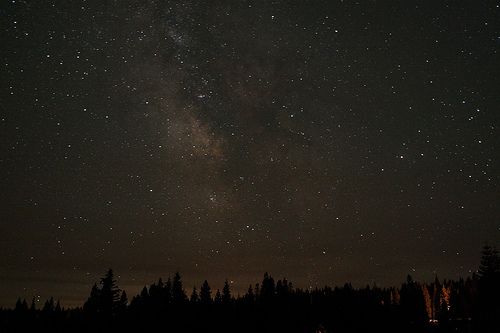
After the initial welcome at the main hall, our teacher led my group up the path to our meditation hut in the forest. On the way there, he stopped us and told us to look up. It was a still and clear night, much darker than we city dwelling visitors were accustomed to. I had never seen stars like that.

“Please be aware,” he said, as we all stared silently, “that you are seeing.”

He repeated himself. I was transfixed on the stars, but I remember thinking, “Well, duh,” when his comment registered. Of course I’m aware I’m seeing. How can you see without being aware of it?

His comment echoed again in my head a moment later, and I realized what he meant. For the first time, I recognized that I was normally only aware of what I was seeing, and had taken for granted that I was seeing at all. My awareness had become preoccupied with the content of existence, not the fact of existence itself. Suddenly, it struck me as so peculiar that there was stuff out there to see at all, and especially peculiar that there was something present — me, evidently — to see it. I don’t know why it had never occurred to me there was anything odd, or at least curious, about this arrangement.

In that instant, the stars became more real, more imposing, though I can’t say their appearance changed. It was something like admiring a photograph of a tree, and then realizing you were looking at a real tree. This experience definitely had an effect on me, but I didn’t grasp its relevance right away. Read More

Post image for To My Fellow Skeptics (and Believers Too)

The first few times I heard about God, I was already suspicious. My earliest clear memory of it was when I was five, leaning against the screen door of our small town home with my older sister, watching a midsummer thunderstorm unfold.

We were in awe, like I have been at every thunderstorm since. I don’t remember if I asked, but my sister said it was God who made the lightning and thunder. Not that she was ever religious, that’s just what her eight-year old mind told me that day. I took note.

At that point, nearly all of my ideas about God had come from Family Circus comics. The kids each prayed every night before bed, depicted casually as if it’s something every normal person does. In one comic, Dolly prays for her father to make it home safely from his trip to New York. The opposite panel shows a rainy street scene in which a six-foot translucent hand stops her Dad from stepping in front of a speeding taxi.

Seriously?

Later on, in my teenage years, I would recognize the Family Circus to be a conservative, unapologetically fundamentalist cartoon, but at the time I wasn’t aware of the play of politics in the things I read and watched. I just knew that the God they depicted didn’t make a whole lot of sense. This was the idea of God I had, and I rejected it, because it made sense to do so.

Sometime in junior high, when I was becoming more politically aware, I remember being shocked one day when I realized that ordinary adults — too old for the likes of the Family Circus — actually still believed in this God thing. Not just the crazies on televangelist shows either, but real, respectable adults who could be found in church on any given Sunday, singing hymns while looking upward with their eyes closed, really believing that they were in contact with this big translucent man, presumably when he’s not busy casting lightning bolts over my hometown, or saving Bil Keane from the natural consequences of wandering into traffic without looking both ways. Read More

Post image for Five Useful Headless Resources

Well it turns out there’s been much more interest in Douglas Harding’s Headless Way than I initially thought. I’ve had quite a few lengthy comments and a lot more emails than normal. Evidently Headlessness has struck a chord with a lot of you, and people have a lot of questions.

I can’t explain everything about it here though, for three reasons. First of all, I don’t want to write about the same topic for too long because I know not everyone is interested. Secondly, I can’t do nearly as good a job describing headlessness as Douglas Harding can and already has. And finally, this is a method of self-enquiry, which means you’ll have to do most of the exploring and experimenting yourself to get the most out of it.

So here are five excellent resources on headlessness, all available from your computer chair. Read More

Post image for Headlessness FAQ

This is the fourth article in a series about Douglas Harding’s method of self-inquiry, called headlessness. The others are here: [Post one] [Post two] [Post three]

In the previous article, I described Harding’s discovery that he, in his first-person, singular, present-tense experience, did not have a head. He insists that anyone who gives it an honest, unbiased look, will find the same thing.

Obviously it’s a preposterous claim, and it raises some questions. Here are the most common sticking points.

What is the point of this?

The point is to experience your true nature instead of just experiencing your thoughts about your true nature.

We tend to see ourselves as what our thoughts tell us we are: separate, finite bodies, tiny compared to the world we inhabit.

Nearly all of your ideas about who you are have been derived from views of you at a distance, either from other people’s accounts, or from mirrors and cameras.

From a distance of a few meters, you do appear to be a finite thing in the midst of other finite things. From zero distance, your appearance is very different, but we tend to disregard what we see ourselves to be, in favor of what we’ve learned ourselves to be from non-first-hand sources. This collection of learnings is called the ego, and most people will never suspect that it isn’t who they are. All of it is second-hand, past-tense, misleading information about who you are, observed from angles that cannot possibly see what you see.

All the major spiritual teachings inevitably point to nonduality — that there is no real separation between you and the universe around you. Many people suspect this is true, believe it is true, or want it to be true, yet it remains only an interesting concept for most.

What the Headless Way (or “headlessness”) allows you to do is to see nonduality plainly. You can physically see the seamlessness between you and the universe that contains you. This has huge implications for our relationships with others, the ego’s negative effects on our lives, human evolution and a lot more. Read More

Douglas Harding was a modern-day English philosopher who made a remarkable discovery about human nature, and developed a simple and ingenious method for guiding others to see it for themselves. This post is the third post in a series about his method. [Post one] [Post two]

Though an architect by trade, Douglas Harding was strongly drawn to philosophy, and his primary interest was answering the simple question of who he really was.

Was he a really only a six-foot bag of meat, animated by some mysterious biological energy? Or was he what the religious and spiritual masters said he was: pure, empty consciousness, undivided from the rest of the universe?

He wasn’t about to take anyone’s word for it.

While thinking about the principle of relativity, he realized that his identity depended on his distance from the observer. Looked at from a distance of a few meters, he appeared to be what could only be described as a man. But from a distance of an inch or so, “patch of skin” would be a more honest descriptor of his appearance. Zoom in further, and he became cells. At closer ranges still he became molecules, atoms, and particles.

He recognized that it worked the other way too. Observe from far enough away, and his close-range appearance as a man gives way to that of a city, then a continent, a planet, and so on.

Careful to avoid assumptions and going only off of objective observations, it was clear that what he was at three meters was nothing like what he was at three nanometers, or three billion meters.

He couldn’t deny that he had many layers of appearances, quite inseparable from one another, and all of them dependent on the distance from which he was observed.

It was also undeniable that he needed all of those layers to survive. Clearly he needed the surrounding planet to breathe and sustain himself, which in turn needed the surrounding solar system to keep it in its life-sustaining position, which in turn needed the surrounding universe to put it where it was, and so on. Looking in the other direction, he knew he also needed his constituent body parts and cells, which in turn needed their constituent molecules and atoms.

This led him to the idea of nondualism, as fabled in religious and spiritual teachings. There was no perceivable separation between the six-foot human he always figured himself to be, and the universe that surrounded it and comprised it. The only separation between Douglas the person and the remainder of the universe was an arbitrary, imagined one: the common, generally unquestioned thought that a human being ends strictly at the limits of its skin. Read More

“The world will ask you who you are, and if you do not know, the world will tell you.” ~Carl Jung

Imagine just having been born.

You don’t know anything. You’ve never experienced anything.

But suddenly there is light, and chaos. You’re exposed, and cold. Blurry shapes are moving all around you. Sounds strike you with an edge much sharper they ever had in the womb. The whole scene is bright and loud, and the shapes move so quickly.

There is so much happening. It is all completely alien and extremely intense. It’s upsetting. You cry.

Among other things, you are seeing what you will later learn to call faces. But they are not faces yet. They are shapes, with a pattern that will soon become familiar to you.

You are hearing what you will later be told are voices. One of them is already very familiar to you. You will be told to call it “Mommy.”

The one thing you are certainly not aware of, is you. You are aware of all these shapes and sounds and feelings, but you aren’t perceiving them as happening to you or to anyone else. You are only aware that they are happening.

How will you ever make sense of it all?

Luckily, you are human (though you’re not aware of that yet) and human minds have the power of association. Without even trying, you begin to associate certain shapes and sounds with certain thoughts. You associate your mother’s voice with comfort. Your mother’s voice becomes comfort. You might associate the dark with sleepiness, maybe loneliness too. You might associate bathtime with fun, or horror, depending on what happens emotionally during your bathtimes.

Associations like this accumulate. From experience, X makes you expect Y. Then X begins to symbolize Y. Eventually X may become indistinguishable from Y. You’ll keep adding them over time.

This is handy for sorting out the chaos around you. You can tell, for example, that the thing with the warm hands and soothing voice is usually good news for you. It’s a simple association. This is the primary tool you’ll use to make sense of the whirling scenes around you.

You are still only looking outwards, and it has not yet occurred to you to inquire as to what is doing the looking. After all, the entirety of existence — every shape, sound, character and story — appears to be there, somewhere outwards. You don’t yet have a reason to contemplate what is at the center of all this action. Read More

Desktop version

Raptitude is an independent blog by . Some links on this page may be affiliate links, which means I might earn a commission if you buy certain things I link to. In such cases the cost to the visitor remains the same.