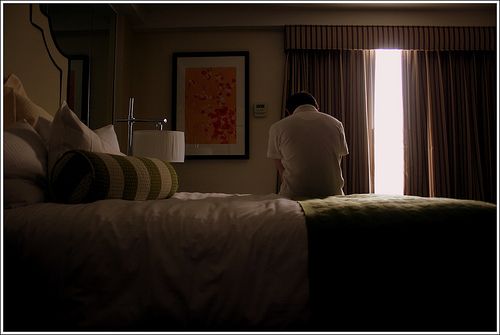
Photo by r.f.m II
Well, it happens sometimes.
I find myself in a lousy mood. Hard to say where it started, but it certainly has something to do with not getting much sleep Saturday night. I had big plans for Sunday, but the day was compromised by my zombie state. I think my IQ shrunk about thirty points from normal, for the whole day. I did everything wrong. I cooked badly, I conversed badly, I wrote badly.
My funk cruised on through today too. Work was a real slog, even though everything I needed to do was easy. I was working outside, which I normally enjoy. I wanted to go home. I wanted some Belgian chocolate. I wanted the Sun to f**k off.
Today I was going to write a more in-depth post on another topic, but when I sat down to do it, it was like pulling teeth. I know I could have churned out something, but it would have been a crusty, callous little post. I just couldn’t resonate with what I was had planned to write about, so I asked myself The Big Question: “Given my dreams and goals in life, what is honestly the smartest way to spend my next 30 minutes?” My answer came: Write about what you can resonate with right now. So I decided to put my crap mood to good use.
The Nature of the Beast
Low moods are a bizarre animal. They’re like a nasty drug that hijacks your thoughts and robs you of your intuition and perspective. They make bad things look bigger and good things look smaller. It’s as if they have their own demented gravity, drawing annoyances and inconveniences — not to mention the crappy moods of other people — out of the woodwork towards you. Foul moods don’t seem to emanate from any particular source, or line of thought, they just waft into your headspace when you’re disappointed and vulnerable. They cast a pervasive dullness on the people you meet and the places you visit, and the things you think about.
Mine is currently sucking the excitement out of certain upcoming events that normally thrill me to think about. My big travel plans, my growing new blog (which is, as I type, having its busiest traffic day ever) and my newly blossoming friendships are all lending me very little joy at this particular moment. Because my mood sucks. C’est la vie.
Thankfully I’ve learned to recognize what it means to be in a bad mood, and usually I can remember what to do about it. Above all else, a bad mood means I’ve lost perspective. I can’t see clearly, and I know it.
In a bad mood, the thinking mind sticks around (sometimes it even goes into overdrive) but wisdom seems to slink away when you’re not looking. The highest properties of the mind — intuition, compassion, patience and acceptance — slip quietly out the door like bored houseguests. Today, even when I looked for them in my head, even when I knew they were exactly what I needed to get back on track, I just couldn’t locate them.
Simply understanding this “wisdom-loss” phenomenon inherent to bad moods goes a long way. It explains why everything looks so bad. Perspective becomes impaired, but you can’t actually see that while it is happening. You just have to remember that bad moods bend things towards the negative end.
Part of the impairment is that your mind tells you your negative outlook is completely warranted. When you simply remind yourself that you are temporarily missing certain important mental qualities, you can consciously defer any bigger decisions and actions until you have your whole mind working for you again.
The most important thing I ever learned about moods is this:
Your mood does not represent the state of your life, but it pretends to.
Looking objectively at the state of my life right now, it’s spectacular. I’m young, in good health, I have friends coming out of my ears, I’ve finally got a long-needed creative outlet, I’m gearing up for an epic trip this fall, I’m generally unfettered by debt, and I even don’t mind my day job. But my bad mood doesn’t care. It doesn’t see any value in those things. I feel no swell of excitement when I think about them. I still want to lay down and put my head under a pillow.
Emotionally, it feels like my dreams have plowed into the guardrail. Bottomed out and spewing smoke. Wrecked. In the past I would have trusted this feeling, and made decisions based on it. I would have pictured an unrealistically bleak future, convinced myself it was well on its way towards me, and panicked accordingly. But now I know bad moods make for unreliable assessments. Tomorrow, all the same things will look different. This I know from experience.
The Role of Physical Interference
I have learned a lot about how to be calm and patient under normal circumstances, but I find physical interference erodes this very quickly. By physical interference I’m referring to any physical discomfort (such as an upset stomach, excessive heat or cold, or hunger pangs) or any mental impairment (such as lack of sleep or the effects of alcohol.) When your body is screaming for something, patience and acceptance are much more difficult to achieve.
Have you ever had someone trap you in a long-winded conversation when you have to pee really bad? No matter how patient a listener you are normally, you probably aren’t going to be too receptive. Physical bodily distress overrides all of your other priorities. It’s just mother nature looking out for you. No time for the luxury of a good mood when you’ve neglected your body.
For this reason, I found it very difficult to be mindful and appreciative at work today because my head was sluggish and heavy and I desperately wanted to be horizontal. Physical interference will probably undermine pretty much anything you do to recover from your mood, until you can satisfy the body’s needs.
The other day I caught the end of a segment on CBC radio where they were discussing happiness. The guest was familiar to me: blogger Gretchen Rubin, from The Happiness Project. As a parting question, the interviewer asked for the one most important tip she would give people for achieving happiness. Her answer was to get adequate sleep. If I wasn’t convinced then, I am after today. The body’s fundamental needs have to be taken care of before one can hope to be stable emotionally.
Recovering from bad moods
The first step is simply to acknowledge you are in a bad mood. Here’s a litmus test: if you can’t get excited about something you are normally excited about, you’re in a bad mood. Remind yourself that your perspective is currently limited, and that your faculties of wisdom are currently impaired or dormant. Remember that any visions you have of the future are going to look unreasonably bleak, any assessments you make are going to be distorted towards the negative. As a bonus, other people are going to seem more annoying than they really are. So take all your judgments with a grain of salt.
Attending to your body’s needs is a sensible first step to responding to a bad mood. Understand, though, the difference between what your body needs and what your mind wants. Your weary body might want sleep, while your flustered mind wants Häagen-Dazs. There is a fine line between mental wants and bodily needs, but it can be hard to see.
To determine what your body is asking for, focus your attention on the physical sensations in your body: observe what your stomach feels like, what your breathing feels like, what your head feels like. Scan the body by closing your eyes and noticing the sensations. Any needs should become apparent, and while your attention is on your body, your mind will be quiet.
A Warning
It is very tempting (and common) to treat bad moods by indulging one’s wants. The Häagen-Dazs approach is self-comfort, not self-love. Beware of this phenomenon: bad moods make you wanty. I say wanty instead of needy because often wants masquerade as genuine needs.
In my experience, bad moods usually spawn a very strong want for comfort. This can be a spectacularly intense desire — it is crucial to handle it sensibly. If we choose to respond with some sort of indulgence, addiction is a very real danger. Most of us have a favorite way of responding to this comfort-lust, and depending on how conditioned we are to it, it can be a killer.
Some people shop themselves into hopeless debt. Some drink themselves into ruined health and relationships. Some eat until they are ashamed and sick. Some throw tantrums and punch walls. Some stare into the television for four hours straight. All of us do something to respond to the desire for comfort, and most often it has some sort of cost.
Once a pattern emerges, it can become more and more insidious and even completely derail someone’s life. The shame of indulging in a comfort habit can reinforce a bad mood, and very often it becomes self-perpetuating. Lives can be taken over and destroyed by it. Watch an episode of Intervention if you don’t know what that looks like.
Think about how you normally respond to the desire for comfort. What does it cost you? What could you do instead that doesn’t have such a cost? Bad moods will come and go your whole life. Don’t let them rob you each time. There is no limit to the number of bad moods you can have, so there is no limit to the amount of money, physical health and self-respect you can lose.
Find another way to behave in those situations. Take a walk, visit a friend, pick up a book, work out, go learn something… anything but give up money or health to this bad mood. In any case, indulging the lust for comfort usually just prolongs the funk by making you feel like you need more of that indulgence to push it away again.
Ugly moods pass more quickly when you acknowledge them, let them visit you for a bit, and avoid chasing them away with indulgence. Remember some guidelines: Defer big decisions until you’re in a better headspace. Take all of your assessments — of people and of situations — with a grain of salt. Do not trust any visions you have of the future, or any assessments of your ability, worth or potential. There is just so much there you just can’t see. Beware of assigning blame. Similar to “Don’t drink and drive” is “Don’t fret and decide.” Wait until you sober up. Sleep it off.
The main rule of thumb is this: know it will be gone soon, and do as little harm as possible in the mean time.
And now I feel fine again. Look at that.

 I'm David, and Raptitude is a blog about getting better at being human -- things we can do to improve our lives today.
Your writing is excellent! Your eloquence is impressive! You definitely have great tips to share here about dealing being in a negative mood. I am reminded of “this too shall pass” – an often mentioned quote and its story about the impermanence of events and things. It’s great that you tune into the “now” and are in a better mood at the end of your writing!
Thank you Evelyn, always nice to wake up to compliments like that! I’m liking Attraction Mind Map too.
Yes, “this too shall pass” is at the heart of it. They do seem to pass a lot slower if you try to chase them out.
Welcome to Raptitude.
Sent here from Thought Catalog. Great article.
“These things come and go.” Is a similar mantra that helps!
Hi, David… beautiful, as usual. I suffered from depression for a long time; that is to say, for a long time I believed those confused thoughts were my REAL thoughts, and an accurate perception of the world around me. I surrendered to them for far too long.
“Remind yourself that your perspective is currently limited, and that your faculties of wisdom are currently impaired or dormant.”
This is the key, isn’t it? Recognizing that those inevitable phases of depression, no matter how short or long, are a temporary lapse in wisdom and healthy perspective, so that we don’t give in to them.
Great post. I’m glad you wrote about what you were feeling, rather than what you were planning. And I’m glad it helped.
=-)
David,
Nice post!
I liked “Bad moods will come and go your whole life”. And so do all other moods. In fact, all thoughts are impermanent and just come and go. It helps me if I try to watch my thoughts without getting too involved.
Hi David,
Great post and good for you for being so open with how you are feeling. Although I am a big believer in being happy, I have my moments of being in a bad mood too. Usually a lack of sleep will make any off mood even worse.
For me, my bad moods usually have to do with feeling frustrated about my career. When I am in a bad mood, I just tell everyone…I am in cranky pants mode. It brings a laugh and that helps ease it. However, nothing lasts forever and the bad mood will pass with the right attitude.
Sometimes we can learn a lot about ourselves when we are in a bad mood. We can recognize our hidden fears and thoughts…it can be a great teacher. So long as the bad mood does not become a way of life.
@ Nadia — It sure does help to just announce your bad mood, doesn’t it? It kind of helps me to laugh at myself and not take it all so seriously.
@ Roger — Right on Roger, that’s a good way of putting it. It seems like you have to get involved, just because they’re your feelings. Observation alone is probably a smart approach.
@ Lisis — Yeah I think I chose the right topic at the right time. I think just going through those thoughts while I was writing really helped my bad mood to get bored with me and leave.
This is a great post, and one I will definitely come back to the next time I am feeling grumpy. I especially love this line: “Ugly moods pass more quickly when you acknowledge them, let them visit you for a bit, and avoid chasing them away with indulgence.” I 100% agree with this!
David, this is great stuff! Intelligent, thoughtful and deep. I’ve heard good things about you from both Lisis and Nadia. Now I see why!
I really like this blog theme too. Everything is very well put together. Very impressive!
I think this post represents the secret to dealing with bad moods – accept it, but don’t indulge it. Transmute it into something beautiful and uplifting.
Thanks David!
@ Michael — Hey thanks, Michael, and welcome to Raptitude. I’m making friends fast online. There are some quality people on this “Inter Net”
@ Positively Present — Yeah I think I will review this post myself when another ugly mood comes along. It’s hard to remember what to do when your mind is cranky.
Dear David,
I saw the nice mention of my blog, The Happiness Project, here. I so much appreciate those kind words and you shining a spotlight on my blog! Keep up the great work. Thanks and best wishes, Gretchen Rubin
Hi Gretchen, thank you for the kind words. I am a fan of your blog (actually a super fan now) and it’s great to hear from you. You keep up the great work too. I like to think happiness is a growth industry.
“Don’t fret and decide” … I love it! Wonderful article and great advice. Thanks, David!
gut das ist perfekt.
Hi Acooba. Welcome to Raptitude. Good to see you here.
I just realized Michael fooled me with this post: http://lovetospare.com/2009/04/01/your-feedback-please/
Really good article, I’ve been in a mood all weekend, just what I needed to read!
Hi Paula, welcome to Raptitude. I’m glad I helped your Monday a bit :)
This is really, really great. Not just this article, but the whole site… I found it today via stumble today and I’ve been reading and nodding in agreement for quite a while now. You should seriously consider writing a book!
Hi Jordan,
Thanks, I’m glad you like it. Heh, a book is probably a ways down the road. Raptitude is still quite young. I’ll keep putting out articles for the time being. Make sure you subscribe, so you don’t miss any.
Great post. Who can’t relate to being in a funk? I agree with Jordan. You should seriously consider writing a book about a young boy who overcomes his fears.
Brenda’s last blog post..On Cats
Heh… maybe one day. For now I’ll do it in blog form.
This was a really great article. I stumbled to another entry of yours and clicked this link through there. I often get into bad moods and never really thought about how screwed up my perspective is when I get like that. But you’re right.
I will be keeping all of this in mind. Thank you.
Glad you liked it Laura. The cool thing is it’s the same for everyone. It’s also useful for dealing with other people’s bad moods. You can take the things they say with a grain of salt because you know they aren’t at their best mentally. :)
David,
This is a very insightful posting, and it seems that by the end of the blog, you were no longer in a funk, probably because you were expressing yourself in writing, where it’s clear you love doing. The key to reducing a bad mood is to force oneself to do the activity (or activities) one enjoys.
Of course, that’s the trick. I think bad mood can be synonymous with depression.
Excellent post — Love your writing style.
I noticed that you wrote about your bad mood to get rid of it. It seems like most creative work isn’t this interesting to us when we’re in low energy states, and I think generally speaking, creative production should be avoided. It’s been proven that people are more creative when happy, and less when unhappy.
When I’m low energy, passively productive activities are key. On the first tier: movies and videos I’ve been meaning to watch. On the second, books and reading, which require more energy to get through.
Hi Alex. That’s my thinking, generally. But the day I wrote this, I had a self-imposed deadline to write something but writing was the absolute last thing I wanted to do. So I wrote about what I was feeling, and it really helped me get past my rotten mood. But normally I avoid right-brained stuff when I feel crappy.
This was beautiful. Thank you.
“your depression is connected to your insolence,and your refusal to praise”
Rumi
Thank you for this site, I think it is wonderful. I am currently trying to catch up on life after 30 years of depression. I’m feeling strong and happy now, lucky me, but I’m waaaayyy behind on wisdom and experience, and the intelligent, original, TOUGH, REALISTIC, well-written advice in this site is helping me no end! I have recommended Raptitude to my therapist/social worker, in case she wants to use it in her work… Thanks, David. Half of me wants to shoot you with a surface-to-air missile for being so good-looking, and the other half wants to give you a big sloppy bristly man-kiss for helping me out.
How about an article on passive-aggressive behaviour? Recently I discovered that I’ve been doing this all my life, that it was mangling my social relationships, and that my family is rife with it. It’s a silent killer – you don’t know you’re doing it. It’s not too widely known about, but it is well documented. Perhaps I could help you write the article (give me a year or two).
Thanks for the flattering words, Simon. It’s always good to hear that my writing actually helps people. I will do a bit of research on passive-aggressive behavior and see what comes to mind.
David,
I did not think any words, no matter how profound or intelligent, could lift me out of the bad mood I have been and still am feeling. However, after reading this, I must say that although all feelings of pity and everything else my mind was convincing me, have not gone away, it has helped greatly. So just a short note of thank you. It helps to know that I’m not the only one letting their mind take over and allowing themselves to eat a lot an awful lot of haagen-dazs on those days. But thank you for inspiring and helpful words.
Samantha
I’m glad it helped Samantha. Bad moods are definitely something we all have in common. Just writing this helped mine a lot :)
.-= David´s last blog ..What Passion Will Buy You =-.
I realized today that I’d been in a funk for the last months, dealing with work and people issues that got me into a state of woe, helplessness and frustration. Tonight I went searching for words of wisdom about the state of funk and found your post and comments so very helpful. Thank you!
From my own experiences of falling rock bottom after excessive self indulgence and laziness, I’d have to say you hit the nail on the head. There’s hardly a better feeling as the feeling of accomplishment, and that’s the feeling that lasts too. Being active and exercising releases endorphins that creates feelings of well being.
I just have one gripe though. I think the happy components of haagen daz should also be seen as an equal importance, and that’s good nutrition.
Haagen daz makes one happy because it’s loaded with carbs and proteins, which both significantly boosts the brain’s serotonin, effectively working as well as an antidepressant.
While haagen daz is fattening and may leave one feeling worse after gaining the pounds, there are much healthier and fitter alternatives to getting those nutrients. PB&J sandwich would do the trick, or a chicken sandwich, a nice pasta dish, etc. These dishes would also provide additional nutrients for good mental functioning.
Hi Mike. I see what you mean, but I don’t know if I’d call a serotonin spike “happiness.” In any case, I suspect the bad mood would still be there after the antidepressant effect subsides, only it might be compounded with shame and fatigue.
Thanks for the response David. I didn’t call it “happiness” but rather “antidepressant.” Being depressed is the state of mind in which one gets an abundance of negative thoughts, often distorted, and a lost of ability to enjoy things once previously enjoyed. Sure there are times in which this state of mind is caused by one’s poor choices in life. But this may just as easily be caused by poor nutrition.
You’re right that a serotonin “spike” is certainly not good, and will indeed feel very fatiguing. That’s actually what makes one feel the “food coma.” The key is to eat many frequent small meals a day which would keep serotonin functioning at an optimum level. :)
Hallo all,
Not going to preach to the choir here, but I’m sure everyone who reads this has been to the bottom of their black-holes and to the peaks of their pinnacles.I’m young, but have been through a bit. I’m a smart guy and have a lot to give but used to be handicapped by a crippling depression. But I believe in the human spirit and I believe in living but I had nothing to believe in going on. In my deepest darkest moments of anguish and gloom, one poem rang through all my lofty cynicism and pain…it that charges me up still..to go on..to go on..to go on. It’s Invictus by Willian Ernest Henley. http://www.bartleby.com/103/7.html
If you are ever at the edge of your hope and will power, please read this poem once. There is no force in the world, no God so powerful, no fate so persistent as the will of a man who will not be defeated even when he is.
This poem is the same poem that Nelson Mandela read to himself every single day for 31 years in jail.
I don’t know who you are or where you came from, but this web site has done for me in three days than 40 years of meds and counseling. You are now my “home.”
Well that’s quite a compliment! It is extremely gratifying to hear you say that. If there’s anything you’d like me to write about, send me a message through the contact page.
David, thanks for this.
I have been struggling with my weight forever, although I have long ago defeated cigarettes, booze and drugs with ease (I hated them). The same recipe doesn’t seem to work with eating, although, it should! I hate being fat!
There are some good suggestions in this writing that may open some doors.
P.S. It’s a great old article, so I don’t feel bad about bringing it to the “top of the list”. Cheers
Thank you so much for this post! I stumbled across it today and it was exactly what I needed right now. I was already familiar with the ideas you shared, but in my current mood they hadn’t occurred to me. So, I’ll hope my bad mood is gone tomorrow and that I can make a fresh and positive start!
I think this may be my favourite post that you’ve done; this post has become a landmark in my mind, a reference I touch base with at least once a week. The exact wording may be muddled with time and the specifics lost, but a few of the ideas here stuck inside my skull like peanut butter to the roof of a mouth – now every time I’m in a bad mood or approaching one I just think: “remember what that post said: you’re just in a bad place. Things aren’t nearly as sucky as you think they are – give it a few hours.”
Some things come into our lives just when we need them, and I wanted to say thank you for being the messenger for something I obviously needed to hear. It’s a big improvement to my earlier, out-of-control mood swings, and it’s given me tools to deal with bad moods :)
I used to experience major mood swings and anxiety during my pregnancy. Ive recently read about keeping mood journals to track your cycles, which apparently really helps keep on top of them. My friend’s agreed so i started a search for the best ones around
i found: http://www.moodpanda.com
which lets you keep a cute, colourful simple mood diary, where u rate your mood and it keeps a graphical history, and plots a calendar of your mood as coloured days! Its much nicer to use than other sites and you can set privacy on it so no one else can read your thoughts
i just use it for fun really, but it could be really useful for you!
hope it helps
Samantha
xxx
oh wow! this is most deff an awesome article besides the many that i have been reading the past 2 days!
this really explains a lot about my “indulgences” when I’m depressed. i eat horribly but that doesnt help because it only makes me want it more, just like shopping when I’m mad stress and depressed!! what a freakin eye opener!
love 88 Important Truths I’ve Learned About Life
and this lil tid bit off to the side you stuck in. Just wanted to add something that’s been helping me rid my negative thinking and low moods.. the problem that is arising as your are automatically thinking and finding yourself all of a sudden in a darkened mood can be figured out later, in retrospec its not soo urgent that in a clear mind LATER when your mind is wiser it can be handled so why not put it aside and resume what you where doing? THis helps me to maintain my level headedness and stop the negative attitude I so habitually tend to do to myself. Hope it helps.
Great post! My compulsion, of course, when faced with someone in the doldrums is to offer a sunny and absolutely useless, “Cheer up!” I feel impotent in the face of such ill humors, and become the Happiness Blurter, which does no good at all. Your suggestions, on the other hand, are all workable and proactive and certainly much better than me and my smiley mug.
Well as a Happiness Blurter, your heart is in the right place. Unfortunately “Cheer up” just isn’t something people can do all the time. We can’t simply decide to end any particular mood, but they do move along faster if you can give yourself a break and let it run its course.
Hi, I just read this post and i myself was in a bad mood today. Reading this has made me realise what i do when im in a bad mood and how it affects my relationship. Boy! am i glad my husband still loves me. Thanks. Im feeling much much better now.
I would like to thank you for the efforts you have put in writing this blog.
I really hope to see the same high-grade content by you in
the future as well. In fact, your creative writing abilities has inspired me to
get my own, personal website now ;)
Hi David,
Undoubtedly, you’re a real attitude. Great writing, great explanations, great finishing. Just beautiful. Impressed a lot with your spectacular writing. And I really aspire to write like you. Thanks and Regards!
When I’m in bad mood, you can never talk to me and at this age I still have tantrums.. I really want to check this to the psychology but I have no time.. Thanks for sharing this great blog.. Love to follow it!
David,
It is so wonderful to know that “out there” there are young minds, might I say, “philosophers” who need to be heard by all.
This internet is a stage for all to hear.
Your thoughts are a wake up call to the young and old alike.
The young still have time to “get over themselves” and the old; well, we can still end life’s adventure with a smile.
Keep on Talking Out Loud… not a bad name for your book…
Such a great post and I love your writing voice! I can hear your wisdom and the witty-ness and humor all intermingled and obviously illuminated in your writing. I subscribed to your website after I read this. Keep up the great work and just know that your writing is uplifting and giving and you are displaying great generosity by continuing with this. Also writing this blog in the midst of your bad mood must have helped you with your funk i’m guessing. It’s funny how that happens when you give but you end up receiving much more. Thank you!
i dont like having bad moods because it makes me even more mad and it gets me into trouble and my friends stopped talking to me. they are no fun, so what can i do to stop the moods? some one please answer me, even though i know no one will. the reasons for my bad moods is my step dad and the way my mom changed to make him happier. well guess what it made me mad and they completely forgot about me. and step dad person made me move time and time again and he says that i have no choice about that and im far away from my family and i know no one and all and he wonders why i dont like him
I’m not sure how I stumbled across your blog – actually I was trying to get some inspiration about what to do with the “rainforest” of paper that was sent home today after my daughter’s 1st year at school..and now I’m hooked. Your new biggest fan! Thanks. Love your thoughts. And i will be keeping all my daughters creative/feeling work samples by the way :)
Good to hear Jaynie. Hope I’ll see you in the comment section again sometime soon.
Hello David just found your writings today,so no time to read all but definately my kind of reading material. A book would make excellent bedtime reading. I am 78 years old and have always wondered what inherent trait or experience forms human behaviour. Reading your articles I find the replies are all about human reaction, very interesting and insightful. Im thankful I still have an enquiring mind- now did I inheret that or was there some influence encouraging me to seek for reasons for everything somewhere in my life? Look forward to reading more of your stuff.
All I can say David is that mood swings can happen anytime but it can be prevented with proper diversion of things you can do.
David this is BRILLIANT!!!… Now I just want to know that in which psychological temperament you do belong b’se I’m melancholy and we are very prone to bad moods. I’d also want to know if any temperament can easily be caught by these ugly moods…If you don’t mind me asking brother.
Thanks.
This is so, so good! Just discovered your blog, David, and I can’t believe the gems that I’ve picked up already just from stumbling around. Relevant, practicable and thought-provoking stuff in a juicy delight of good writing. Thanks and congratulations to you, sir ;)
I’ve read this before but now that I’m reading it while experiencing it it’s interesting…
I let some bad thoughts of a recent break up take me over and prevent me from sleeping (the sun is almost up) I know this isn’t right, but I just hate to go to bed upset because I know that as soon as I put the stimulation of the computer away my mind will be free to entertain itself with whatever it wants, and it usually wants the worst thing possible. It got this bad when I tried a little music before bed, some of my favorite artists, and it ran a rampage then! So I guess this is my addiction, give the brain something else to do besides think of the offending topic. A lot of the time it means giving up sleep. But thanks to your article I know that going to bed (now that the sun is coming up) will be the only way I can feel better.
Thank you, David.
Reading your post makes me feel like you’ve been interpreting what has been going on inside my mind for such a long time. Though I am known to be someone with a great sense of humor and have helped my friends snap out of a bad mood in seconds; I often find myself draped in feelings of negativity and depression. But like you said, “now I know bad moods make for unreliable assessments and tomorrow, all the same things will look different.” So I have conditioned my mind to always wait for tomorrow to see things from a different perspective.
David,
You’ve got some killer articles on here. They’ve truly helped me, who has been dealing with far too much stress and anxiety, to lighten up and realize how happy I can be with the right mindset. I’m sure I’m not the first to be helped by your work, keep it going, you’ve really got a talent for this.
Good! Run with it.
Just so you know, I had a very upsetting night at work. When I got home, I was in a terrible mood and everything seemed to be an absolute tragedy.
For some reason, though, my instinct was to go to this blog. I read a few of your articles, and I hope you take pride in knowing that I feel so so so so much relief. I feel like I’m breathing normally. Thank you so much for your writing. I hope you never give it up. You’re very talented at it, and we all soak up your energy like it’s oxygen.
Jessi
Thank you so much for this article! It was extremely helpful, and I think I’m going to save the text of it to my computer so I can refer to in the future when I lose perspective. I often feel, anxious, depressed, and overwhelmed, and these feelings make me constantly shift my life philosophy and general approach to living, so much so that I’m usually in a constant state of confusion. This article gives me hope that I can shake this habit and just accept that periods of depression are not an indication that my worldview or lifestyle is false, but rather a simple, unavoidable fact of life. Thanks, again!
I really think that the perspective you took on this subjet is of great depth, looking at it in a very intelligent way (even thought as you said it, you were impaired by your mood, leaving us to think that you practice what you preach, you put yourself to do something usefull and also fought another enemy, boredom, kudos ) I love to learn day by day with this blogs, I wanted to thank you for sharing. One got to give to live, thanks for giving. Best regards
Great article David. Eventhough I have done tons of “Recovery work” I still slip occasionally into a mood. My approach is a conscious observation of my mood…then ” let Go”..and Direct my conscious to a task..that the mood is directing me from coompleting…
Have a Great One….
I careful ready your blog and I found it very interesting, perhaps because ultimately I feel my self in a bad mood, often. Maybe, under this very same mood, I question my self, how about good mood. Isn’t that also an “… bizarre animal… like a nasty drug that hijacks your thoughts and robs you of your intuition and perspective. In turn they make” good things look bigger and bad things look smaller. “It’s as if they have their own demented gravity, drawing” enjoyment and conveniences…
If so, isn’t that bad as well? How could you recognize such state of mind?
Love this article! Thank you so much for writing it. I am currently writing a blog post on how stress is a choice and would love to include this article somewhere in my content :) Keep up the great work, I will surely be back!
Hey David,
I really admire your positive thinking. It shows your optimism!!
Your suggestions definitely come in handy!!
I think sleeping it off or working it out is the best solution.
It refreshes the mind and clears irrational and emotional thinking.
However, something i have noticed in the past is that when people fail at something or under go a severe change in their life. They react to it in the form of a “bad mood”, and a good way to tackle this is to sit down n note all the problems in a journal and figure out the best way to deal with it.
I really needed to read this article this morning, thank you so very much for writing it.
I have really intense mood swings when I’m in a bad mood, I go from dignified and in-control to rabid and volatile and I’m very afraid of who I become when I’m in a bad mood. I’ve lost a lot of friends and ruined a lot of peoples days, all because I had a tick on my shoulder and it didn’t stop at strangers and friends but it also interfered with my family life as well. I’m only 19 now and I’m still learning how the world around me works but my biggest goal, the one that I want to conquer more than anything on earth is how to avoid being a jackass.
Thank you again, great website too. It’s refreshing to just see text and a solid color background instead of a bunch of flashy images and gradients.
Hey…loved this article. I really needed to read that today. It helped put things in perspective and stopped the negative thinking cycle. It is very true that we create our own reality with our thinking. I’m going to get up and get moving and focus on the positive…You have a great gift for writing that can help people.
Thank you for this article. It really helped me understand the thinking cycle of bad moods that I have observed in someone very close to me. I will be better able to not take them as a personal attack and just wait them out patiently. . .
I was suggested this blog by my cousin. I am not
sure whether this post is written by him as noo one else know suc detailed about my problem.
You are incredible! Thanks!
“Physical bodily distress overrides all of your other priorities. ”
This is what makes dealing with anxiety so difficult. No matter what you try to tell yourself during an “episode” (job interview, speaking in front of a group, etc.), the physiological changes that occur during anxiety are difficult to temper. Once the rush begins, it can spiral out of control and quickly overwhelm. Still working to reprogram my mind and genes:
http://wakeup-world.com/2012/03/26/the-science-of-epigenetics-how-our-minds-can-reprogram-our-genes/
Each and every line of this content is marvellous and stinging.Very effective way of pairing wisdom back!!
You have so much insight into this topic! I can feel most of what you’re writing here, partially I’ve been through it and partially I just realized where my indulgences lie because I read your article. I seek comfort either in my bed (sleep/ watch reruns of favourite tv shows like friends, Frasier or star trek) or I work 7 days a week in 2 jobs and spend my time off just sleeping. I thought this was the path to getting better, but it made me neglect friends and family so it seems to be just another dangerous habit. Your article just totally made me see that for the first time. Thank you!
Thank you for writing this! I really needed this today, I woke up in a pretty crappy mood… no apparent reason why, just did. Actually, I take that back, it may be because last night wasn’t really the best of nights. Nothing really in particular bad happened, just one of those nights, you know. And that, sort of sunk into today, I think, but thank you for this article, I needed to be reminded that I’m maybe not in the best headspace right now and that I just need to accept that so I can work on moving past this mood.
Thank you. I needed this. very very much.
Hi David, this is my first comment, but I’ve been reading your posts for about a year now. Your posts always seem to come at the right time of my life and always leave me feeling uplifted. I’ve been in a bad mood all week but after reading this you’ve really helped and I hope this will help me deal with negative thoughts and feelings in the future. I really appreciate what you do, Thank you!
R,
Thank you for sharing your take on the side effects of bad moods and how to deal with them. What helped me in this small but power packed read is in relating use of ‘comfort habits’ when the bad mood is around. I have identified one of my most predominant comfort habits and have noted that I do it frequently, however I didn’t think it was from a continuous bad mood. I like the reference to human body reactions predisposing us to enter the bad mood syndrome. I have known of this cycle for years and your thoughts and opinion rewritten here have some how driven the point to my conscious mind. Nice writing~~~L
Comments on this entry are closed.
{ 56 Trackbacks }