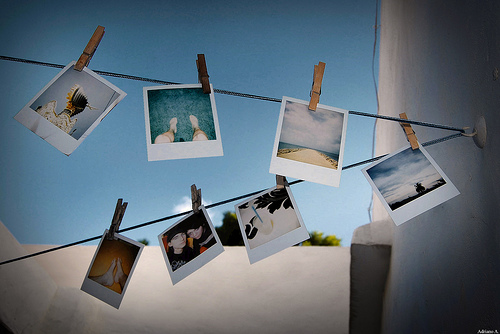
If you read Raptitude you’ll see me talk a lot about moments. By the end of this post you’ll understand why I use that word so much. I grew up thinking the word moment referred to specific instants in time, usually where some significant event occurred. There were historic moments, life-changing moments, poignant moments, tense moments, touching moments, Kodak moments. They were events to be remembered, reminisced about, or photographed.
Whatever they were, they held you captive. Everything else seemed to drop away, and you just watched. They seemed to be isolated from the normal, linear course of time.
As for the rest of life, it just seemed to be the normal, steady current of ‘stuff.’ Some fun, some pain, some hope, some confusion, some excitement, some tedium. Same same but different.
When I was twenty, desperately leafing through some forgotten self-help book, I came across a peculiar line. It didn’t astound me at the time, but it still stuck in my head. It kept appearing in my thoughts. I think I detected a hint of its significance, but it was years before I fully appreciated how powerful it is. Now I believe it is the most important thing I ever learned:
Life unfolds only in moments.
Nobody has ever experienced anything that wasn’t a moment in action. And all those moments have had one thing in common, they were all now once.
So if you think about it, you may picture life as a whole stack of moments, like a stack of photographs that show what happens in your life instant by instant. The present moment sits at the top, and past moments extend down from there. New moments drop from above, as the seconds tick by. That stack of moments is your life. Right?
Well, not really. There is no stack. If there were, you could just lift a photo out of the middle and it would be as clear and vivid as the one on top. You could sift through your past at will, and see every detail just as if it were happening again. You could pick a moment from way down in the stack, maybe your fifth birthday, and recall every detail.
I remember parts of my fifth birthday, I think. My mom actually made us cupcakes instead of a cake that year, one for each kid. My guests’ cupcakes each had one candle, except mine had five because I was the birthday boy. Of that I’m certain, but I sure couldn’t tell you what I was wearing, or list all the kids who were there. I’ve got one or two details rattling around in my memory, but the moment itself is gone.
Of course I have memories, but they are poor facsimiles of the moment they are supposed to represent. Those memories are not a part of that moment. They’re a part of this one, right now, where I’m sitting in front of my computer on the evening of April 1, 2009. They are not a part of October 8th, 1985. Even memories can only happen now.
I cannot access my fifth birthday in any way; I’m stuck here. Now.
There’s really only one picture, but it keeps changing. We can remember when it looked different, but we can’t see its past incarnations with anywhere near the clarity we can with the present one.
So my fifth birthday is as dead as Ben Franklin. This sounds kind of sad, but it’s actually fantastic news.
If the scope of life never extends beyond one moment, that means you never have to deal with more than one moment. You can bring all your attention and resources to bear on making the smartest move right now; there needn’t be any other considerations. This means that there are not a million things to do, or a million people to please. All you ever have to do is observe the moment that is happening, and pick an action that makes sense to you.
 It often doesn’t seem like it, but life is always presented in these convenient, manageable slices. The scope of your power as a person cannot extend beyond this single moving snapshot, so there is no reason to attempt to influence anything beyond it. Observe the moment, pick what strikes you as a smart move, do it and watch what happens. That’s the only responsibility you ever need to live up to. It encompasses everything you can possibly do in life, so don’t kill yourself trying to reach further than that.
You do not have to figure out your future, or come to terms with your past, because there is no future or past. Any experiences that seem to be from the past or future are not experiences at all, they are just thoughts. Those thoughts are all just features of the present moment.
Try this:
Hold your hands up, palms facing each other, one beside each ear. Feel the heat radiating from your head, and get a sense of how small the space is between your hands. It’s not much bigger than a basketball.
Every single thing you’ve ever experienced, every sour memory, every embarrassment, every triumph, every great fear and every great hope, is confined within the space between your hands. All conceptions or visions of your past and future are right there floating above your neck, and they cannot be found anywhere else. They have no weight of their own, no permanence. They can take no form other than that of a fleeting thought.
Rather than experiences, thoughts are more akin to a sudden noise: they arise with a frightful clatter, and are just as suddenly gone, leaving no trace. Unfortunately, the human mind has some inefficiencies. The mind doesn’t automatically make a distinction between experiences and thoughts about experiences, regardless of whether those experiences are remembered, anticipated, or imagined.
If they are mistaken for the actual experiences they represent, the person thinking them can react as such, with the same physical and emotional distress they might have if they were actually experiencing them. These physical responses can trigger other thoughts, and the subsequent torrent of ‘noise’ can take on the appearance of a whole lifetime of regrets and worries. They are still insubstantial thoughts, but the physical and emotional reactions they trigger are concrete and real. Simply recognizing thoughts as the phantom ruses they are can halt this process before it happens.
Neither the future nor the past can ever be dealt with, and they don’t need to be. You only need to deal with your present-moment thoughts about them. When you are not having thoughts about those two realms of time, they bear zero relevance to your life. You can safely let them go and feel free to deal with the living moment at hand.
This truth, once I fully understood it, released a huge weight from around my neck. Life wasn’t crushing and heavy, it was as light as air. Thin as a photograph. I was finally able to look into each moment as if it were nothing more than an infinitely detailed and poignant living picture. I could finally take the moments one at a time, because I understood that there never was more than one. I could appreciate and observe each one, and know that my whole life lies within it, not just a tiny fraction. There are no ghastly fears out there, stalking me from somewhere else, waiting to pounce. If they existed, they’d be right here, in the picture for me to look at with the rest of the scenery. Moments do hold me captive, and everything else does drop away. But they aren’t few and far between, they’re broadcast live, 24-7.
Moments can be observed with clarity, and can be navigated deftly, but our whole lives are just too vast to be managed at all, no matter how strong or organized we become. The crushing weight of one’s entire past is always too much to bear, as is the frightful spectre of another forty or fifty years rife with dilemmas and tragedies. It’s far too complex; there are too many contingencies and unknowns. Surely something in there will overwhelm or destroy us.
A human being just can’t deal with that, and often it feels like the best we can do is distract ourselves from it. But we don’t need to.
We just have to recognize that there is no ‘out there’ at all. Life is in right front of you, all of it, always. And there isn’t any more to it.
Photos by Adriano Agulló and copyriot
Did you like this post? Get Raptitude articles via RSS feed. Or if you prefer, get them by Email. It’s easy, and free!

 I'm David, and Raptitude is a blog about getting better at being human -- things we can do to improve our lives today.
Very beautifully said, David.
David,
You’re an excellent writer. I’ve read many books on Buddhism and I’ve never heard of living in the present moment described better than what you’ve written. Do you study Buddhism?
Brilliant. Insanely brilliant.
I don’t even know where to begin with a response. I’m going to have to start responding to your posts by writing entire posts on my own site. We’ll have a blog to blog conversation going.
;-)
I’ll settle for telling you my favorite part from this post:
“Those memories are not a part of that moment. They’re a part of this one, right now, where I’m sitting in front of my computer on the evening of April 1, 2009. They are not a part of October 8th, 1985. Even memories can only happen now.”
What a beautiful way to tie the past into the present. This moment is, indeed, the only one we have.
Aw, you guys are great. I’m flattered.
Yes, I’ve studied some Buddhism, Roger. I would like to learn more. One of the best books I read was called Buddhism Without Beliefs, by Stephen Batchelor. He takes a nonreligious approach to Buddhism that I found really, uh, enlightening. Definitely worth a read.
Hi David,
I’m new to your blog and am grateful to have discovered it – what a treat this post is! Thoughtful and inspiring.
You made an excellent point that will keep me thinking (and applying) all day. Thanks!
I agree that neither the future or the past can be dealt with. The whole purpose of my blog is to focus on living positively in the present moment, which is pretty difficult actually. It would be great if we could be taught from a young age not to worry so much about the past or the future and to just live in the moment, but I am 25-years-old and I am just learning this now. Thanks for a great post!
Great post, David. Isn’t amazing that when we remember something, our brain reacts as if it is happening now?
Yes, life is about moments and nothing is better that living in the moment. Someone once said that the reason why the present is a gift is because it is called the present! A play on the word but still so true.
@ Nadia — Yes, and not just the brain, but the body too. If you just take a minute and think of a dire or scary situation, you might feel your breathing change or your heart rate increase. The body thinks there’s a real threat, which only inspires more worrisome thoughts.
@ Positively — I know, I really wish I had learned these things as a kid, it would have spared me a lot of trouble. I’m hoping that the idea of staying deliberately present becomes more widely known, and eventually works its way into the education system. The benefits for society and culture are too great to ignore.
@ Laurie — Hi Laurie, welcome to Raptitude. I’m glad to hear it’s improved your day in some way. I hope to be seeing more of you around here.
Hey David. Loved this article! Really beautifully written and I enjoyed every moment of it.
I loved the idea of photos and reminded me I used to horde photos, as though as I was wanting to hold onto all those moments. A couple of years back I realised they were holding me back. Part of my life force was in those pictures, not in living here and now where I’m meant to be. Hard as it was, I threw 95% of them away. I kept only those that represented people who had been part of my life or key moments from my kids growing up. I just couldn’t part with those .. but the 95% I did let go was such a relief.
Hi Ian, welcome to Raptitude.
I loved what you said about photos. I know the feeling of trying to ‘stockpile’ moments with photographs. Often when I’m on vacation, I find I’m always trying to get the right picture of something, and I even feel a bit of stress about it. I’m focusing so much on trying to take the moment and keep it, that I miss the actual experience in favor of a tiny keepsake. I love photographs, but they are a far cry from the real deal.
I remember being 17 and standing on Cocoa Beach in Florida about to watch a Rocket launch. Most of us kids whipped out our cameras so as to not miss the amazing moment, and our teacher asked us if we wanted to remember seeing the rocket launch, or remember taking a picture of a rocket launching. I put my camera away and 14 years later, I still remember it like it was yesterday. It’s definitely better to live the moment than try to capture it. Pictures are only a trigger for memories anyway. it’s the memories themselves that can stand alone
I wrote about that very phenomenon once — putting away your camera on purpose.
https://www.raptitude.com/2009/07/moments-cant-be-captured/
Hello David! I saw the link to your blog on the StevePavlina forums. You have a really unique and artistic sort of writing style. I really enjoyed reading this post.
I guess we really do use photographs as a way to capture those moments that we will never be able to relive again.
Have you ever read any of Eckhart Tolle’s work?
Wow David,
I am thoroughly impressed with your in depth approach on really living in the “moment”. Your words are beautifully woven together into a tapestry of thoughts.
I agree with you on how we can visualize each “moment” with clarity like photographs.
There are studies on how our past experiences can be magnified through the levels of intensity with our 5 senses:sound, sight, taste, touch, scent.
You mentioned that each moment is like a photograph.
“There is no stack. If there were, you could just lift a photo out of the middle and it would be as clear and vivid as the one on top. You could sift through your past at will, and see every detail just as if it were happening again. You could pick a moment from way down in the stack, maybe your fifth birthday, and recall every detail.”
From this perspective you pointed out, can the different intense levels of experience through our 5 senses plus emotions/feelings affect the “clarity” and “area of focus” on our photograph?
@ Vinny — Hi Vinny, and welcome to Raptitude. There are certainly some details imprinted in our heads from past experiences, and they can bring associated memories back in a flash. For example, to this day when I smell leather, I immediately think of being in a leather shop in Florida when I was ten. I think the people who were there, the thing I bought, the feeling I had about myself at the time, it’s quite amazing.
But I still can’t access most of the details of that moment, they’re just gone gone gone. I’d like to read the study you’re referring to, it sounds interesting.
@ Ching — Hi Ching, welcome. Yes, I’ve read all of Eckhart Tolle’s work. I’ve never found anyone else who could describe so clearly what it means to be present. To anyone else who hasn’t read his books, I highly recommend them.
Thanks to both of you for your feedback, please subscribe to Raptitude so I can hear from you on a regular basis. Raptitude is very young but we’re already forming a great community here.
Yes I can definitely relate to what you’re saying about remembering “leather” and all of its related memories with it.
I could not find out exactly the study relating to memory and our 5 senses but these are similar to what I was getting at.
http://www.memorygood.com/increase-ability-of-your-memory-by-using-five-senses.html
http://knol.google.com/k/kevin-spaulding/the-five-senses/3smazt4fj02nv/23#
http://books.google.com/books?id=Pq7OjORR_UIC&pg=PA38&lpg=PA38&dq=increasing+memory+through+5+senses&source=bl&ots=j1RrWhvp5h&sig=Z2k1RL2nYy8GoPTb4d3jqVWOKbw&hl=en&ei=82_YSarQFYKctgP80emtCg&sa=X&oi=book_result&ct=result&resnum=1
My apologies to the long links David but I hope you find them interesting.
Great post David, heavy and light at the same time.
cheers,
Angus
Hey Angus, thanks. Good to hear from you.
Very true well put… Just read a book by Eckhart Tolle The Power of Now and it is relates to alot of what you are say here.
I agree with this completely and have tried to live it for a while now
but i have one question:
how do you do the right thing NOW without acknowledging where you have come from?
For example, after a break up you feel badly about your mistakes and are contemplating when/how/if to apologize, give back gifts etc
you are forced to think of the past to make the right decision
because if you choose to do nothing and not come to terms with it and apologize you are still taking an action.
[Inaction is STILL AN ACTION!! (this is perhaps one of the most important things ive learned)]
I know you are not advocating inaction but how do you deal with things involving the past? mistakes that call for apologies, lessons that need to be remembered etc.
That’s a great question Sonia.
A lot of present-moment actions do require looking at the past, but all of that is still happening in the present. The question is always “what to do now?”
The thing to remember is that contemplating the past is still something that happens in the present. Things only happen in the present, even though it seems like “looking back” is actually accessing the past.
So to answer your question, I don’t suggest not acknowledging where this “Now” came from, only remembering that it’s only the present that you can respond to directly. You can’t deal with the past, it’s completely inaccessible.
Apologies, for example, only address the situation as it is Now, not what the situation once was. Your memories of how it became that way may help you decide what to do, but maybe they aren’t good for much else.
Ah, I think I understand.
I am currently in the position where I THINK I need to apologize to someone. Although my actions were not that severe, I dislike hurting people and dragged out a breakup longer than it should have.
I keep torturing myself over my mistakes and find it very difficult to stop. I get that mistakes happen; I just hate when it affects another personally and how they may view me.
Until I do, I don’t think I can truly apologize for hurting another persons feelings.
Any advice on how to stop this self torture?! I think I feel that if I let go its a) truly in the past b) giving myself an easy card out i.e. do something and let it go since its “done”
I wrote a big long-winded response for you and then lost it somehow.
Here’s the gist though:
-You can’t do much about what others think of you. Other people’s thoughts are based on their own weird and personal emotions and they’ll probably come up with all kinds of conclusions about you that you can’t control. One of my favorite quotes is “What other people think of me is none of my business.” What is usually so troubling about other people thinking badly of us is that we often think they might be right. If we knew they were dead wrong, it wouldn’t matter. Does that make sense?
-If you keep thinking you should apologize for something, then I bet it would make you feel a lot better if you did. Usually when I can’t let something go it’s because I know there is something I should be doing that I haven’t done yet.
.-= David´s last blog ..49 Beds in Four Months =-.
Its crazy how we hold on to things and cause problems for ourselves, hashing out the what-ifs and if-onlys. I find that I focus on past events or unchangeable things too often and create roadblocks for myself. I mean, if I stopped what would I do?! succeed?! haha ;) Id have to focus all my smarts and brainpower towards something else and its a daunting thing to start building the life you want (that you also fear you may not get); it becomes an easy habit to just repeat patterns.
thanks so much david! I really appreciate it
loving the positivity of your blog :) well done
Thanks Sonia.
I think you’ve hit on something huge here Sonia. I know that I’ve caught myself worrying about things I can’t change so that I wouldn’t have to address things I can change. The mind is so sneaky.
Dude, you have got to read The Power of Now. You and I had the same realization. I feel like Eckhart Tolle is the best person at explaning it in the world right now. But you did a great job!
I have read The Power of Now, and I’m a big fan of Tolle. I agree, he’s able to articulate this concept better than anyone else. I should read it again.
Hi David,
You are so right about everything, why worry about everything all the time and always overthink stuff, just let your gut-feeling speak and do the action for you, do whats seems to be the best action and then dont mind about the rest. I try every day to apply your theories and its helpin me a lot, even though I think its too late for some bad habits that I have been encrusting myself with for so-long..
Main one is this: I’m always scared im forgetting to do something; I always go over in my head about stuff I need to do and what I should do today and even though im not that busy of a person ( maybe its because of that) I always fear to forget something to do ( even if I keep track of most of the things I need to do in an agenda)…So many times in the day ill go over stuff in my head hoping I remember everything but I always got that feeling that im forgetting something…I think about things instead of doin them kinda thing… I have been workin on this but its still not at his best…I use to drain so much energy doing that and most of the time I didnt do anything I was just thginkin about stuff I had to do…it was kind of cutting me from reality a lot…I was half there, just like if my body was there but my mind was mostly drought to those thoughts…I was wonderin if you had the key to why I dont have to do that, cuz I know I dont its just hard sometimes..I just wanna live care free for the rest of my life…I dont think its too much asked! thx hope you got what I meant
New to this website but I am so grateful that I found it. I have been on spiritual path for a while (seeker) and you clear a lot of my uncertainties
Love the way youdescribe living in the present moment here. Thank you
How do you make plans, make decisions? Don’t you need to envision future moments when making choices? E.g. stay in one city or move to another. Maybe not, I am not sure, could you post your thoughts? Thanks.
Well. when we’re “thinking about the future” we’re not really seeing future moments. We’re making up a future based on our expectations, and making adjustments in the present moment based on our best guess about what the present is going to become. But there is no actual future out there moving towards us. We just know the present will change, and we can use the past to get an idea of what it might change into.
But life will never take any form except for a single, present moment.
Hi David..re>THE MOST IMPORTANT THING I EVER LEARNED. I read this with great interest and believe you to be quite the prolific writer. I must remember to thank Jesse for introducing your blog to me. { I am his Mom } Just wondering though if you have considered Almighty God and where He fits in all of it. If you want real TRUTH David you will find it in Jesus Christ as He is the TRUTH. Would love to hear your input on this. Thank you for your time.
Hi Judy, good to hear from you.
I think of Jesus Christ as a key figure in human history, an enlightened teacher, like the Buddha, or Lao Tsu. I believe they were all teaching the same thing, only they had different ways of relating it to their students. I think Jesus and God, as we as the ideas of Good, Evil and Sin have been completely misrepresented by the corrupt churches of the Middle Ages, and much of the original message has been lost.
So I cannot take any scriptures (Christian, Buddhist or otherwise) as the face-value, granted truth, because they have all been interpreted, edited, and delivered to us by fallible human beings, and so they are subject to distortion and misunderstanding. Religion is an earthly, human institution, rife with human error and manipulation, despite its noble purpose: facilitating communion with God.
For that reason, I will never identify with one religion or belief system. If you learn about all of the major religions with an open mind, you soon find they are all hinting at the same Truth. With these different perspectives a person can get a clearer image of what Jesus was trying to teach.
The Buddhists refer to it as “the end of suffering,” and the Christians call it Salvation. In the Phillipians it is referred to as “the peace that passeth all understanding,” because it cannot be comprehended in the same way we might understand, say, how a refrigerator works. It is only a first-hand, non-communicable experience that can’t be preached or bestowed. I don’t think any one belief system gives people exclusive access to it, so I make a point of learning about it from all different perspectives. I think it’s important not to believe that we have found The Truth, because then we stop looking.
So yes, I have considered it and many other viewpoints, and I learn from each.
“And so I tell you, keep on asking, and you will receive what you ask for. Keep on seeking, and you will find. Keep on knocking, and the door will be opened to you. For everyone who asks, receives. Everyone who seeks, finds. And to everyone who knocks, the door will be opened. (Luke 11:9-10)
I really like this article and how you show how both worry and regret simply rob the present moment of its joy. So much of what we treat as facts are either stories we tell ourselves about the past or setting up expectations for the future. The living is in the now. Well done. :)
Why say life “unfolds”?
I say, silly man, of course you can plan and execute a future. I say, analyze the moment in order to control the kinds of moments that are made available. Moments are made.
That you think “life unfolds” without thought or plan, merely means you rely on the thoughts and plans of others to fold up a life for you to experience, in wonder, moment by moment. Remember the story of Hansel and Gretel. This thing called “now” is malleable and subject to our control.
Why said it isn’t? If you just stand there and watch, you can see clearly that life does unfold all by itself, whether you have plans or not. You have control over your volition, but your volition is only one part of the present moment. I’m not sure what you’re trying to argue here.
Hey. Thanks for commenting back, that’s cool. I’m saying that life is made by how the living conduct the moment. You are the one suggesting that one way to participate is to merely stand there and watch, right? What are you watching? I’m adding that one can also participate by creating the moment. What are you creating? Ask yourself: Are perceptions created or discovered? That you suggest life can be “all by itself”, separate from the one who creates or experiences it is perplexing. How could you know this? Such knowledge is not revealed in the moment.
Yes, but that’s not really what I was getting at. Obviously nobody can live life without acting, without moving to change circumstances.
But whether you are acting in the moment, or merely observing its changes, or both, life continues to unfold. It is constantly becoming something else. There is plenty we can create with our volition, and plenty that will be created without it. I never meant to suggest that the experience is separate from the experiencer.
So, I’m wondering, what makes you think life is folded up? And why do you think life is becoming something else, when it might just as well be that it is becoming itself? And what do you suppose are the things we can create? Isn’t the execution of a plan different from the creation of the plan?
“If [the thoughts about actual experiences] are mistaken for the actual experiences they represent, the person thinking them can react as such, with the same physical and emotional distress they might have if they were actually experiencing them. These physical responses can trigger other thoughts, and the subsequent torrent of ‘noise’ can take on the appearance of a whole lifetime of regrets and worries. They are still insubstantial thoughts, but the physical and emotional reactions they trigger are concrete and real. Simply recognizing thoughts as the phantom ruses they are can halt this process before it happens.”
-From this excerpt, I agree that, although just thoughts of experiences, the person mistaking them as the actual experiences they represent, can indeed react with the same (or similar) physical and emotional response as if they were actually having the real experience.
However, if this response is a pleasant or favorable one, why halt it? Why not enjoy the same physical and emotional bliss again that the actual experience originally provided? You stated “the same physical and emotional distress” and therefore put it a negative context. I put it in a positive one.
So when you wrote, “These physical responses can trigger other thoughts, and the subsequent torrent of ‘noise’ can take on the appearance of a whole lifetime of regrets and worries.” One could equally say “…of a whole lifetime of joy and happiness.
Any comments?
Also, I too have studied various religions with an open mind. Their GOALS might be similar (nirvana, happiness, eternal bliss, peace of mind, peace, eternal love, life in heaven, etc.), but they are definitelty not hinting at the same Truth.
I’m currently leaning towards Buddhism, which isn’t really a “religion” in the same sense as the other religions, but I won’t get into that right now. Doctrines are subject to distortion and misunderstanding and original messages do seem to be lost through time and numerous translations. However, with Buddhism, you need not one word of text to become a Buddhist. Consider the original Buddha. He came up with all these profound realizations and discoveries through meditation (i.e. simply thinking and deeply contemplating thoughts using his own mind). Today, Buddhist teachers constantly remind me I don’t need to take their concepts at face value, but encourage me to test them for myself.
That being said, Buddhism, so far, is the only religion I’ve come across where a person of a small tribe living in some remote location isolated from the rest of the world, could come up with the beliefs and concepts of Buddhism him/herself. No one needs to tell you. I can’t say that about any other religion, can you?
Sonia caught my attention with “[Inaction is STILL AN ACTION!! (this is perhaps one of the most important things ive learned)]” A favorite saying among Buddhists is “Don’t just do something. Sit there!” Not really sure I understand it (yet), but it’s interesting that that’s basically what you were saying.
Sorry so long. I’m done.
Well depending on the circumstance, you may not want to. But it my experience, positive thoughts don’t have that same compulsive character, because negative thoughts often come as the result of a panic reaction, a sense of threat. We don’t get a “fight or flight” reaction from joyful thoughts.
Have you considered lifelogging as an organizational tool, to let you navigate your memories with perfect clarity? You could extend your now to include the past :)
Somebody said it: Now is the great Is/Was. The portal through which all future plunges into the past.
I stumbled upon a post of yours the other day and took a look around. I decided everything here is worth reading. I’m beginning with your oldest posts and making my way forward. So far everything you’ve said is…in line with my goals and with my own thoughts. I’m having trouble articulating it but, it’s as if everything you’ve said so far is a well worded version of my thoughts and desires that I’ve found hard to put into words and it really helps to see it all written out so clearly.
This particular post made me cry, I’ve been at times obsessed with a painful event in my life that occurred now 6 months ago and still it’s rare for a day to go by without it crossing my mind. This single event seems to have pulled me out of the ‘now’ time and time again. But the idea that the past isn’t ‘real’ is comforting, after all it’s no longer happening. They are just thoughts now, they have no impact on me when I am not thinking them, and those thoughts certainly can’t be found in the world around me. They effect only me and they come from within. This I have known but it still is touches me to read this, “Neither the future nor the past can ever be dealt with, and they don’t need to be.”
They don’t need to be, it echoes in me. They don’t need to be…
Thank you for those words, they do inspire me.
Thanks Dar.
they have no impact on me when I am not thinking them
This really is the important part here. Thoughts can do something to us, they do affect our body and our experience in the moment. But the past events that they represent are not real, and the negative effects of those past events is limited to what a present moment thought can do to you.
And like you say, you can’t ever deal with those events. They are static impressions, and your thoughts will always represent something unchangeable. But you can deal with your thoughts.
Thank you David, your message has given clarity about being present to the moment.
The statement “The mind doesn’t automatically make a distinction between experiences and thoughts about experiences”. I firmly believe being present to this distinction will help one to focus on the present moment.
Wonderful article. I first learned about ‘ living the present moment’ concept from Eckhart Tolle’s book. Completely changed my life
I LOVE this article. I came across it back in 2009 and i just wanted to let you know that I have come back here and read it many times since then. I wish I was better at always thinking this way because this philosophy has helped me a lot with my life. Thank you for that. You’re a great writer.
This is amazing. I am getting better acquainted with mindfulness and presence in the moment, and this article served me so well. You have a way of expressing these deep, profound truths that is crystal clear and easy to receive (not woo-woo at all). Thank you.
Spoken like a true Zen master. Thanks for sharing with us, very clear and rings true within me. Keep up the good work and keep on trucking my friend!
Hi David,
I enjoy reading your blog for a while by now. This is the first time I guess I needed an urge to post a comment.
Although, I differ (in one sense -not totally) in the idea of past and fututre being ‘totally’ dead, I appreciate the idea of ‘the moment’ so much. I learned this 9 years ago, when I happened to be listening to someone reading a little passage from a book which stroke me to the minutest particle at that moment, and changed my life forever. The writer was telling his own self (and someone was reading it outloud):
“…you resemble a foolish commander, who, although the enemy’s right flank joined his right flank and became fresh forces for him, he sent a significant force to the right flank, and weakened the centre. Then, while there were no enemy soldiers on the left flank, he sent a large force there, and gave them the order to fire. The centre was then devoid of all forces. The enemy understood this and attacked the centre and routed it.
Yes, you resemble this, for the troubles of yesterday have today been transformed into mercy; the pain has gone while the pleasure remains. The difficulty has been turned into blessings, and the hardship into reward. In which case, you should not feel wearied at it, but make a serious effort to continue with a new eagerness and fresh enthusiasm. As for future days, have not yet arrived, and to think of them now and feel bored and wearied is a lunacy like thinking today of future hunger and thirst, and starting to shout and cry out. Since the truth is this, if you are reasonable you will think of only today…”
Now? After almost 9 years, I’m still reading the same book which has many more mesmerizing psychological analyses like the one above, and it still helps me change my life for the better. When I read your post, it reminded me of that, and I understood again how outstanding points your posts could have. Thanks for sharing with us.
P.S. Since the quotation above is a translation from Turkish and I’m not native in English, sorry for any mistakes in advance.
David, I read this article some time ago and although I understood what you meant, it didn’t really hit me until a couple of days ago while making coffee. I was thinking about one thousand things at the same time, and out of the blue I realized the only problem I had to solve at that time was to make the coffee properly. I don’t know how I didn’t realize that before! God, what a relief, thanks a lot, seriously!
You write straight to my heart. I’m sure you’ve heard, “We spend the rest of our lives getting over our childhood!” Oddly enough, I had an amazing childhood ~ but, I’m not sure I was prepared for the deep thoughts of adulthood, the disappointments to the heart stuff. You had me wanting to cup my hands over my ears by the time I got to the basketball sized head piece. Powerful. Life is full of lessons; and they are all swirling around inside that little head. Thanks for the reminder that it’s just stuff. Too much to burden ourselves with, for sure. That’s a fantastic attitude!
http://www.hushhushheart.com/5-surprises-a-woman-learns-from-a-breakup/
Be here. now. this was a lovely reminder! Thanks David for writing so elegantly.
Great to see and read content that is of great value. I established a movement with my students in 2002, while teaching in Colombia. It is called the Mind Power Revolution. It continues to grow slowly now that I am back in Toronto. It has many similar notions but the greatest is the evolution of our Mind to process this human experience, in the moment.
Thanks for your efforts to enlighten the masses.
This may come as a shock, but what amount of time is defined as a moment.
Good question. I use it casually to mean the indivisible amount of time that is happening Now. In “A Tale for the Time Being” a Zen nun says there are 65 moments in the snap of a finger, which I guess is a way of saying everything is in a perpetual state of change, and this stays true no matter how much you zoom in. Each moment is supposed to be an opportunity to change your path.
Comments on this entry are closed.
{ 41 Trackbacks }