
I’m in the back room of a coffee shop right now, switching
between writing and another mental exercise: pretending I’m not here.
I don’t mean I’m wearing a disguise, or hiding behind a
potted plant. I’m doing a perspective-shifting practice that I’d recommend to
anyone: now and then, wherever you are, look at the scene in front of you as
though it’s happening without you.
From any seat, or standing spot, anywhere—in an office, a breakfast diner, a public square, a waiting room—see your surroundings just as they’d be if you weren’t here to see them.
Focus on the look and feel of the setting. The way the light lays across things. Take it in like a shot from a movie. Notice the movement and speech of people or animals, the soundscape and overall ambiance. It’s just a little corner of the world where things are unfolding, and you’re not here. Maybe nobody is.
When you do this, you might notice a certain lightness or simplicity arising. Things are more poignant. Everything seems less complicated, because it’s just stuff happening, not stuff happening to you.
Read More
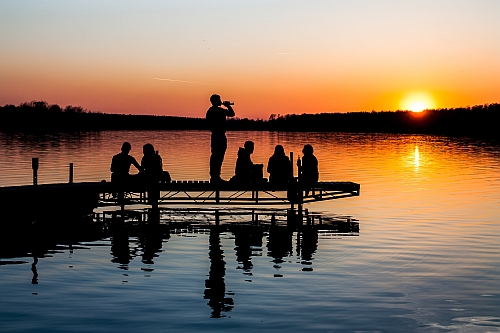
My whole life, no matter where I’ve lived, what my job was, or what I was preoccupied with, one consistent source of comfort and peace has been idly hanging around with other people at the end of the day.
I’ve always appreciated the calming effect of slow evening hangouts with friends or family. But recently I’ve come to think of it as something essential to our health.
The location doesn’t matter really. A back porch. A coffee
place. A front step. A bench facing some kind of water. You just need to be
with one or more people you like, and you need it to be the latter hours of the
day.
Read More

At breakfast one morning, on a silent retreat in Nanaimo, my friend Marc was looking out the window at a lawn sprinkler when he glimpsed a tiny detail he would later write about.
The sprinkler was the ratchet kind, the sort that goes “chh-chh-chh-chh” as it rotates and shoots water, then winds itself back up and does it again. At one particular position in its arc, one particular “chh,” he saw a little rainbow flash across the spray and disappear.
Presumably I was elsewhere in that same room at this time,
no rainbows in sight, contemplating my boiled egg and muffin.
He wrote a blog post about the momentary rainbow, describing it as a perfect example of something contemplatives call dependent arising—the idea that every phenomenon emerges from the vast sea of causes and conditions that came before it.
Read More
A few weeks ago someone commented on my new post, saying
they had just stumbled across my blog, and that it was “very old school.”
I took that as a compliment, and got to reminiscing about what old school blogging really felt like, compared to today. Something’s definitely gone missing—some quality that made it vivid and exciting, and I want it back.
When I started in 2009, and for years afterward, I just wrote stuff, having absolutely no idea if anyone would relate. I wrote as well as I could, but there was a wonderful off-the-cuff feel to the process. If it was interesting to me, it might be to someone else. So I would write something about it. The incomparable joy of campfires. The rich history of a particular dent in my car.
Read More
For whatever reason, whenever I resolve to get good at
something, I habitually take a “boot camp” sort of approach. I draw up a
challenging regimen, to be followed by hell or high water—for 30 days or so.
The regimen is always way too much to sustain forever, and I
know that. The hope is that an intense period of focused striving will catapult
me to new, higher realms of prowess and confidence, so that when I return to
baseline, that baseline will be higher.
It works, sort of, sometimes. You can look at my experiment logs to get a sense of the mixed outcomes. Some have been abject failures, almost comically so. Write at least a thousand words a day! (Result: “Outright failure.”) Read a book a week for a year! (Result: “Catastrophe.”)
And those are only the immediate outcomes. Longer term, the
results are probably weaker. On many occasions, I soared through the boot camp
period, declared myself permanently improved, and then quietly slid back to the
baseline, which apparently had not moved.
For a long time I assumed that this pattern was due purely to my own personal bumbling, and not a problem with the method. After all, a boot camp style approach can be found for anything you want to get good at. There are programs that identify as “boot camps” for novel writing, personal budgeting, dating, poker, building a YouTube channel, reading the Russian masters, and of course hundreds of fitness programs.
Read More

If you time-traveled to the 1960s, or even the 1980s, and tried to describe smartphones to the people you met, they wouldn’t believe you.
It would simply seem too good to be true—an affordable, pocket-sized
device that provides:
instant telegrams or phone calls, from anywhere to anywhere, usually free
maps of virtually every city or rural area, even showing current traffic conditions
searchable encyclopedias
up-to-the-minute news about anything in the world
step-by-step instructions for doing virtually anything
quick translations between dozens of languages
endless articles, courses, movies and TV shows
a camera that takes stills and video, and can transmit them to anyone instantly
the means for
anyone to create their own regular column or newsletter, or audio or video broadcasts
the ability to adopt new functions at any time, usually for free
These are just a few basic smartphone functions, but to your new friends, they would all sound like life-changing superpowers. Their imaginations would run wild at how much easier such powers could make their lives.
Read More

When I had a job, it was easy to know how much work to do in a day: somewhere between as much as I could, and as little as I could without someone calling me out on it.
Now I’m my own employer, and that clear standard for “a
respectable day’s work” is gone. I’m constantly negotiating with myself over
how hard to work, when to tackle the trickiest tasks, and when to take time
off.
I realize that many people, both employees and self-employees, don’t have this problem. They work as hard as they reasonably can every day. These people get a lot done, and face problems of burnout and obsession, rather than lack of productivity.
This article is not for them. It’s for those of you who perpetually
struggle to get the important things done, especially when there’s flexibility
in what and how much you do on a given day: entrepreneurs, novelists, inventors,
or really anybody aspiring towards something that may or may not happen.
Read More

In a
last-ditch effort to enjoy my social media experience again, I unfollowed 90%
of my Twitter feed—and I think it worked.
When I check
in now, in just a few minutes I catch up on everything said by the ninety or so
people I follow. I have time to consider what they say. I don’t leave upset.
It’s similar to how Twitter felt when I joined. In 2009, it really seemed to connect you to the pulse of the online world. That sounds like satire now but it really felt like that. The original concept was very modest—a tweet was only supposed to be the answer to the question “What are you doing?”
The banality of it was part of the fun. Ah, you’re working on a fantasy novel at Starbucks. Neat. I just read a blog post about stain removal methods, which you might enjoy. Here it is.
Read More

I can’t believe this, but I did double-check the math: Raptitude first appeared on the internet ten years ago today.
That day it had one reader: my mom. But soon there was a little gang of eight or nine regulars. Then there were enough to fill a schoolbus. Then a plane, a concert hall, an arena, and a stadium.
There’s so much I want to say about this last decade—reflections, lessons learned, plans for the future—but I’ll do all that later. Today I just want to take a little tour of where we’ve been together.
Here are the biggest articles from each of Raptitude’s first ten years, in terms of reach and popularity. One of them is probably the first one you ever read.
Read More
At the height of Summer, I try to go for a short run after
I’ve done some writing but before it gets too hot, which is usually about 11am.
The most uncomfortable part of the run comes at its very end, just after I step inside my front door, into the small, poorly ventilated foyer between the door and the stairs to my second-floor unit. Nothing happens in that space except the putting on and taking off of shoes.
As soon as I step into this hot, stagnant space, the
intensity of the whole run seems to congeal in my body, kicking on all the
recovery systems. The heart is still thumping, breathing still heavy, and the
sweat glands open up like faucets.
It’s gross and unpleasant. At that moment, there’s nothing I want more than to kick off my shoes, strip off my running clothes, and go sit in front of a fan with a glass of ice water. (I’m a reluctant athlete, descended from cold-climate people.)
Read More
 I'm David, and Raptitude is a blog about getting better at being human -- things we can do to improve our lives today.
“Enjoyment always requires attention.” Love this! Such a fresh take on mindfulness. ❤️ I found your blog when Becoming Minimalist linked to it, and am really enjoying it, thank you!